Winter Hikizuri in Late Summer

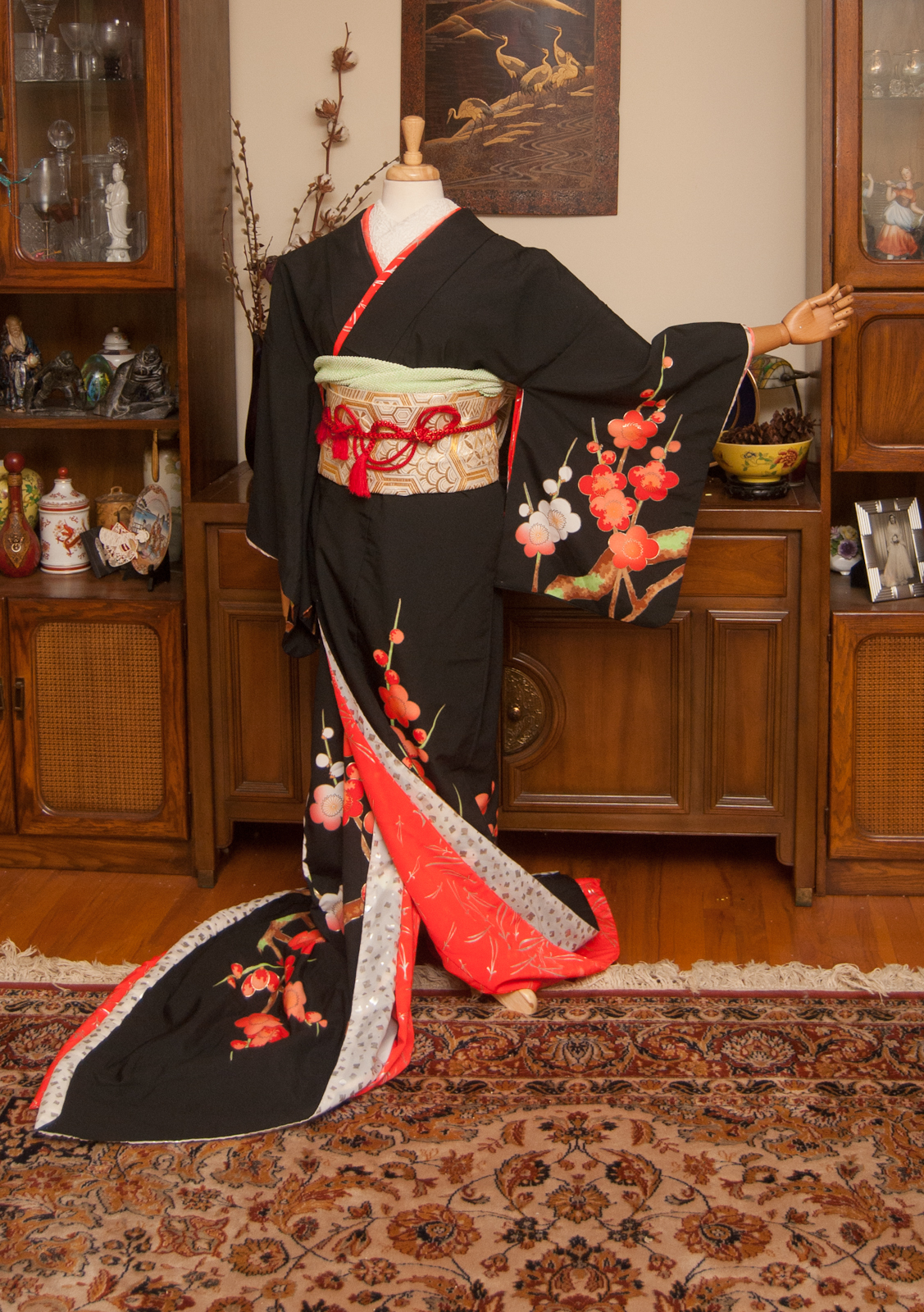
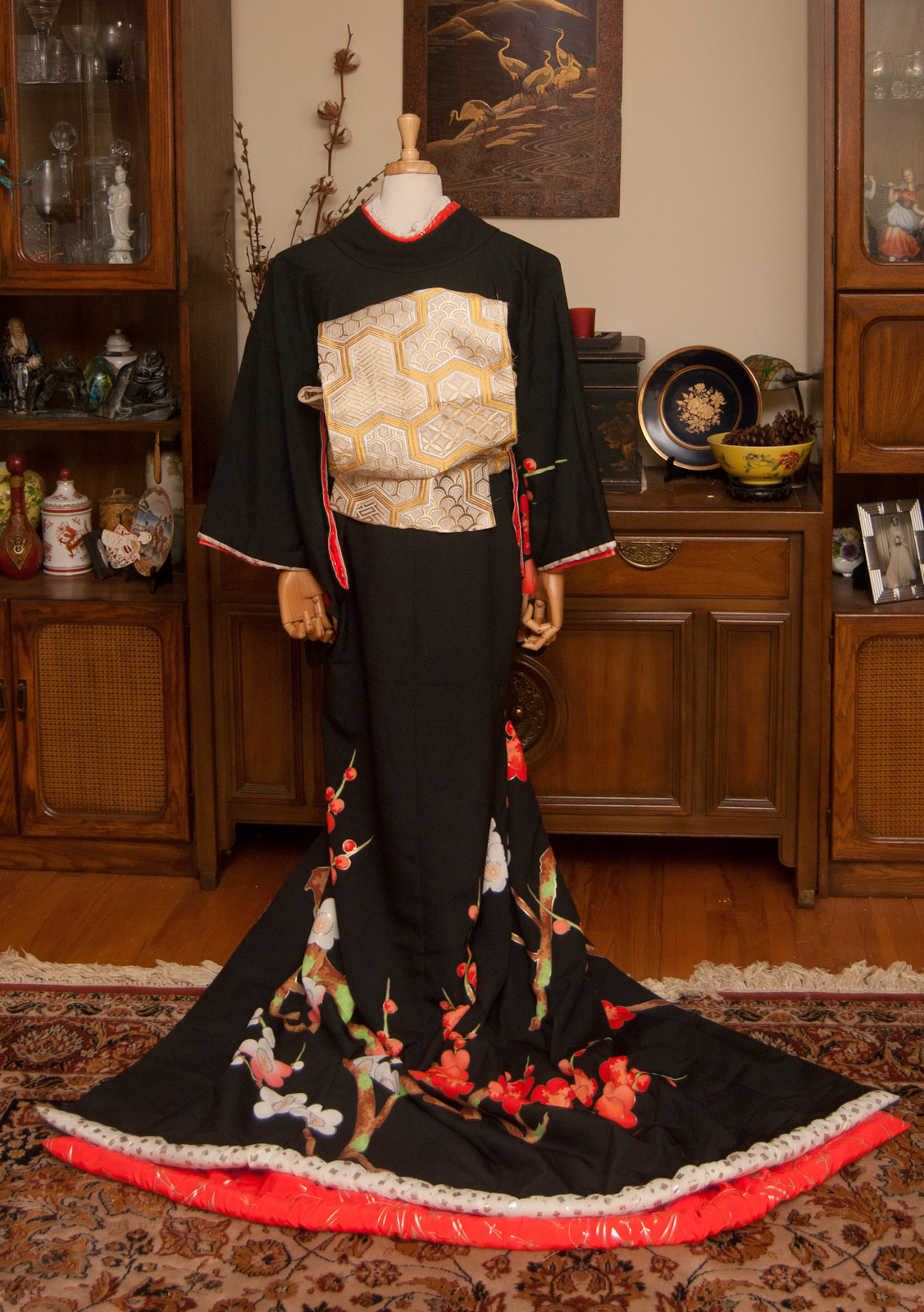
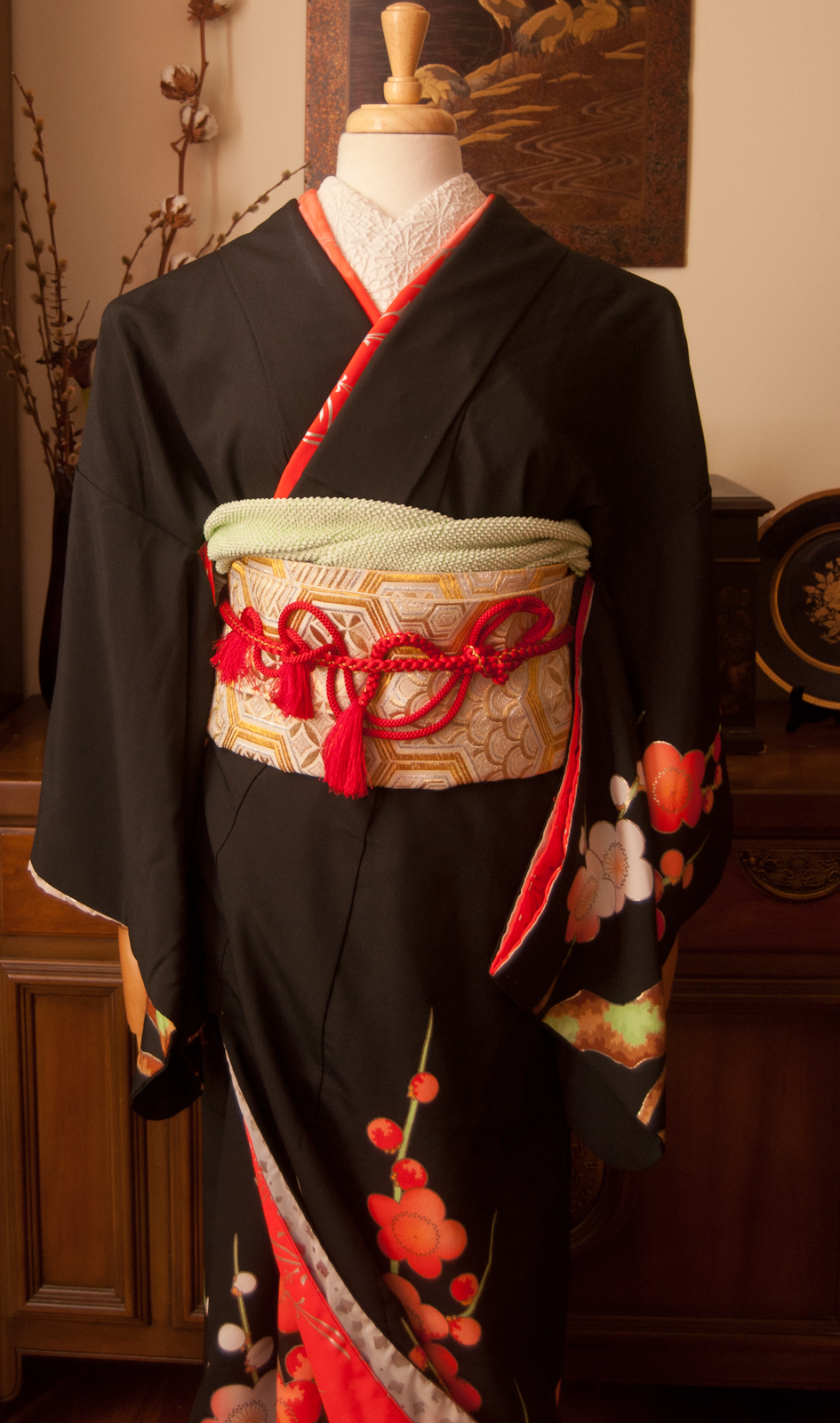
Recently the naughty voice in my head told me to browse eBay, despite having no job and no storage space. I figured browsing hikizuri would keep me safe as they tend to be out of my price range anyway. Unfortunately, I listened to the naughty voice, found a gorgeous ume piece with multiple extra layers that happened to be a huge size, and now this stunner is now all mine! I’m fairly certain it will fit, but right now it’s just way too hot to wear something with so many layers and so much padding. I am looking forward to putting it on eventually, but in the meantime I couldn’t wait to put it on the mannequin instead.

It was listed as a geisha’s hikizuri on eBay, but the overall boldness and huge padded hems make it feel more like some kind of stage or dance piece. Either way, it’s absolutely stunning and it’s already a treasured part of my collection. I chose metallic, heavily textured accessories to balance out the rich black and smooth yuzen. The green shibori obiage isn’t technically appropriate but I really love how it draws attention to the green accents in the kimono that almost disappear otherwise. I think next time (maybe whenever I actually wear it) I might go with a white-and-silver obi instead of the primarily gold one, since most of the metallic accents on the piece are silver, but I think the gold works just fine. I tied the musubi on a bit of an angle to make it feel a bit more chic and I quite like how that looks.

This also happens to be the 100th kimono I own, if you count men’s items, uchikake, and yukata. A piece worthy of the milestone, in my opinion.

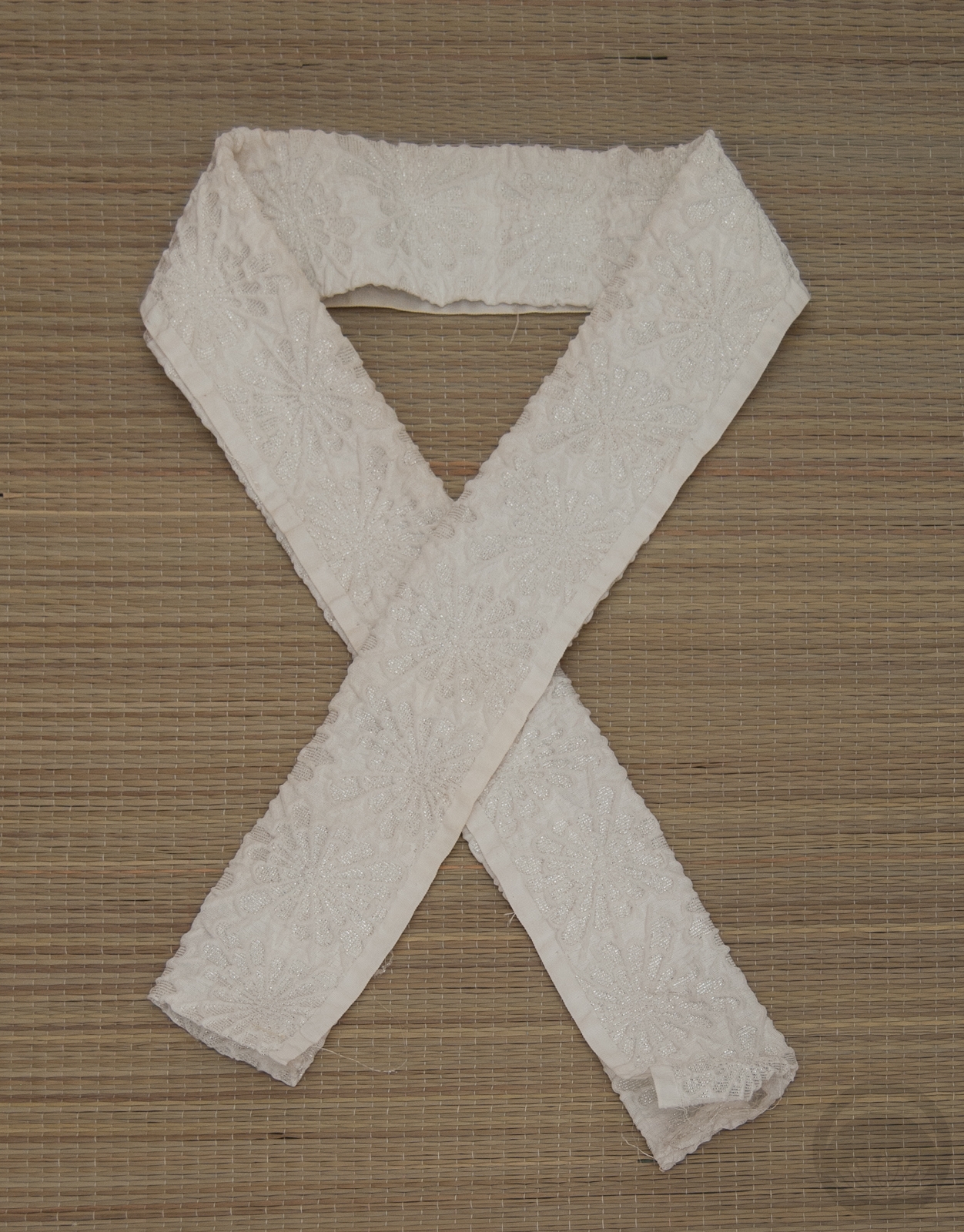
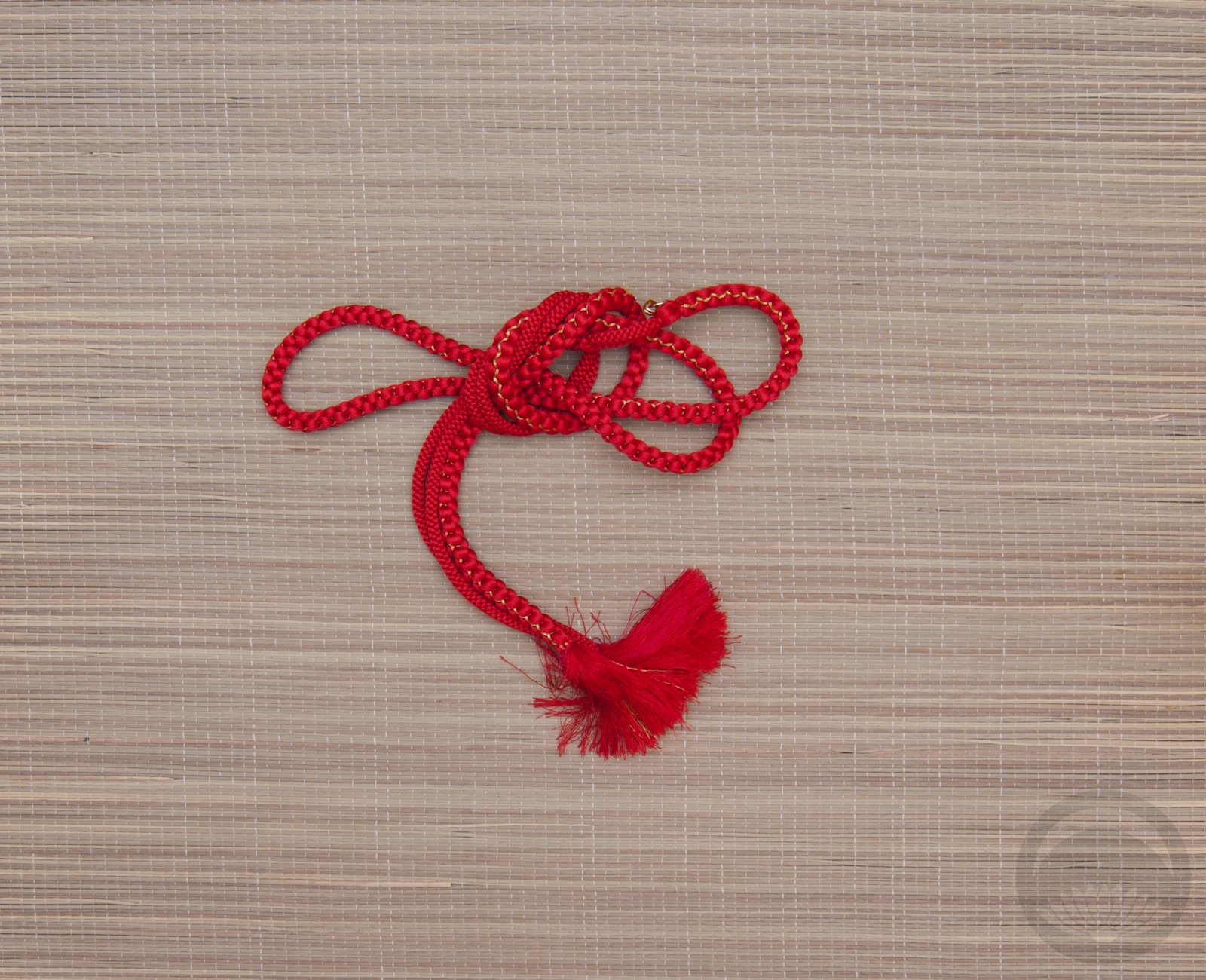
Items used in this coordination

A Punch of Pink!

What’s this? I’ve worn kimono twice in less than a month?! Apparently unemployment agrees with me…

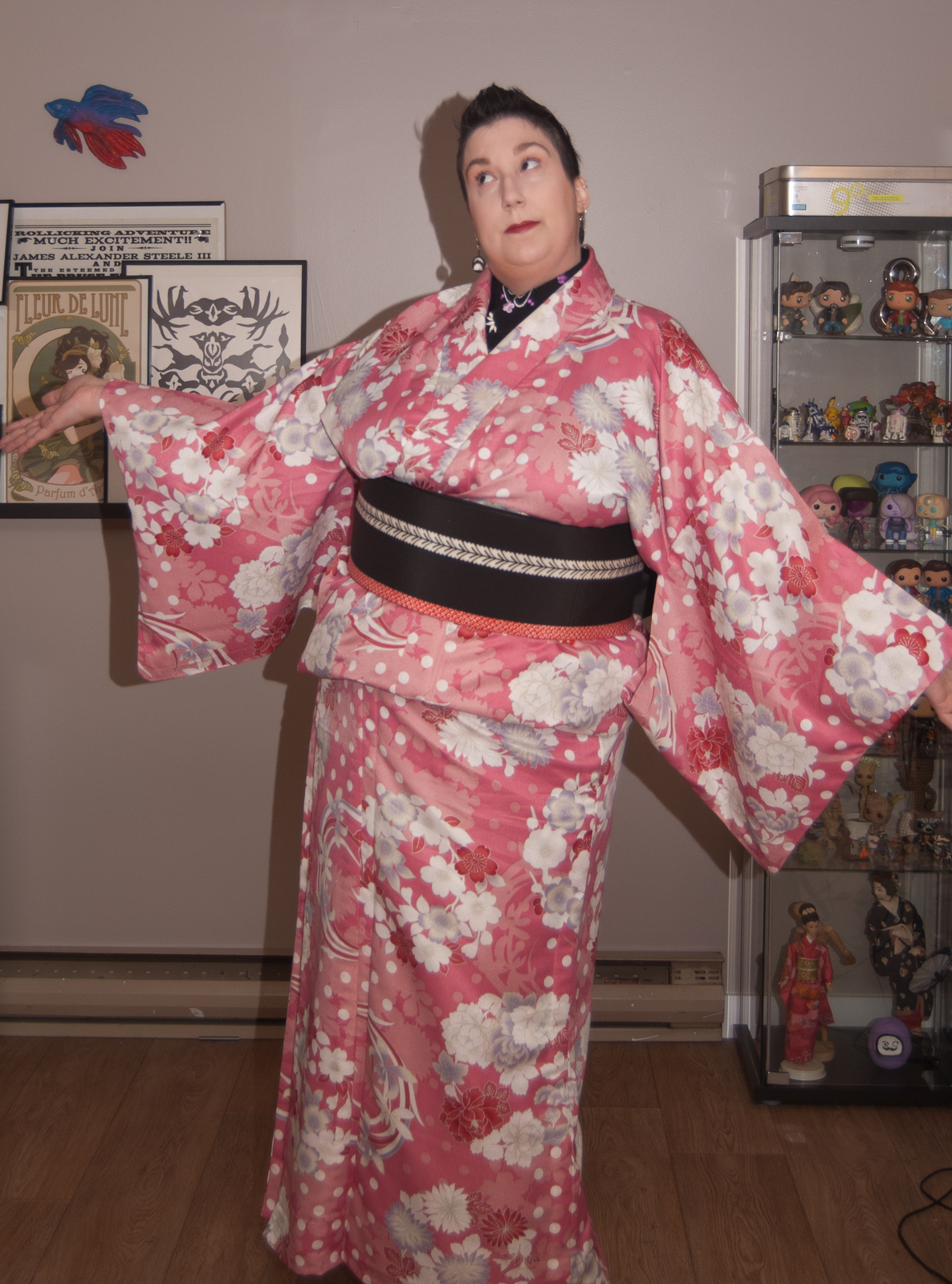
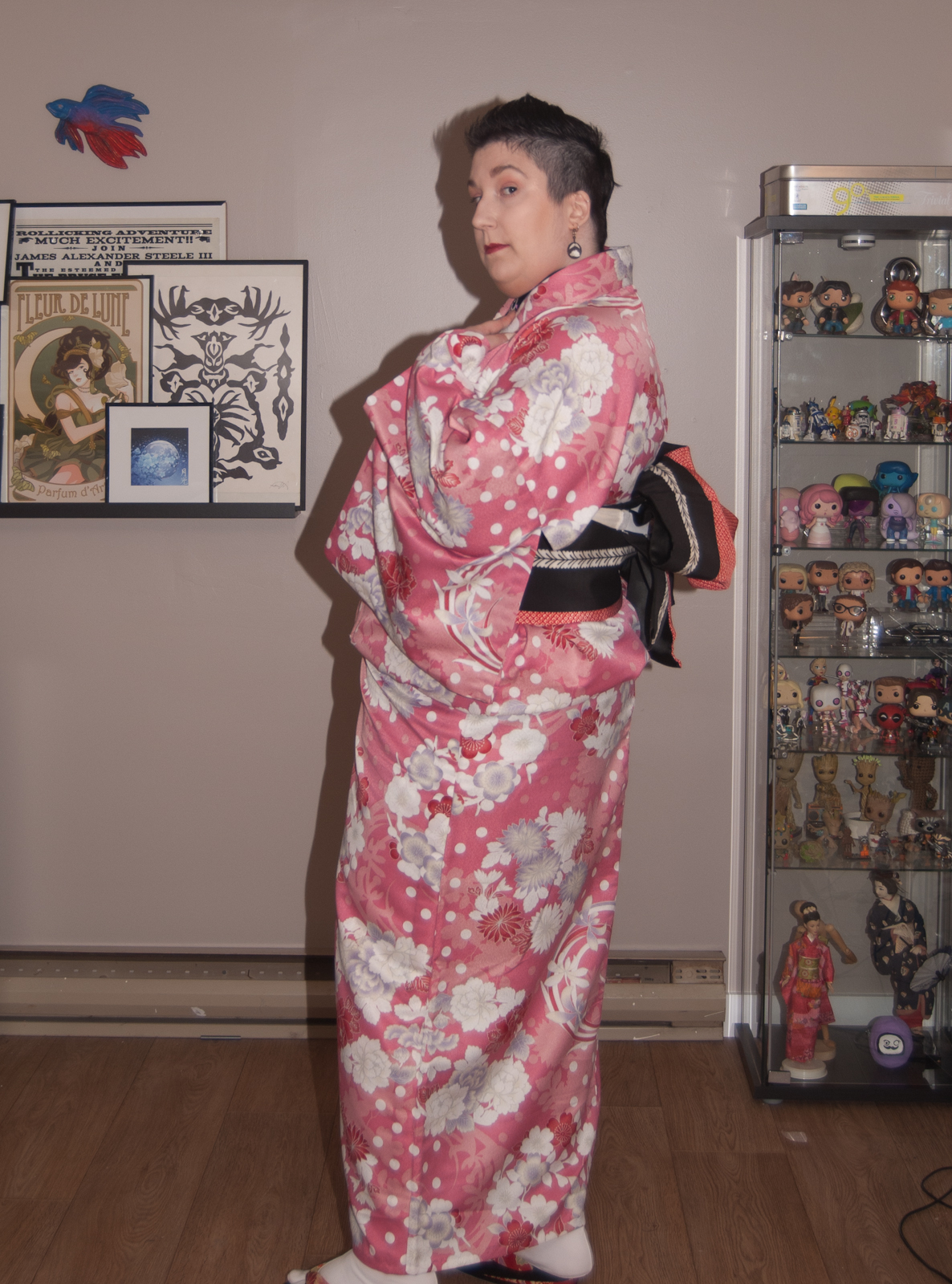
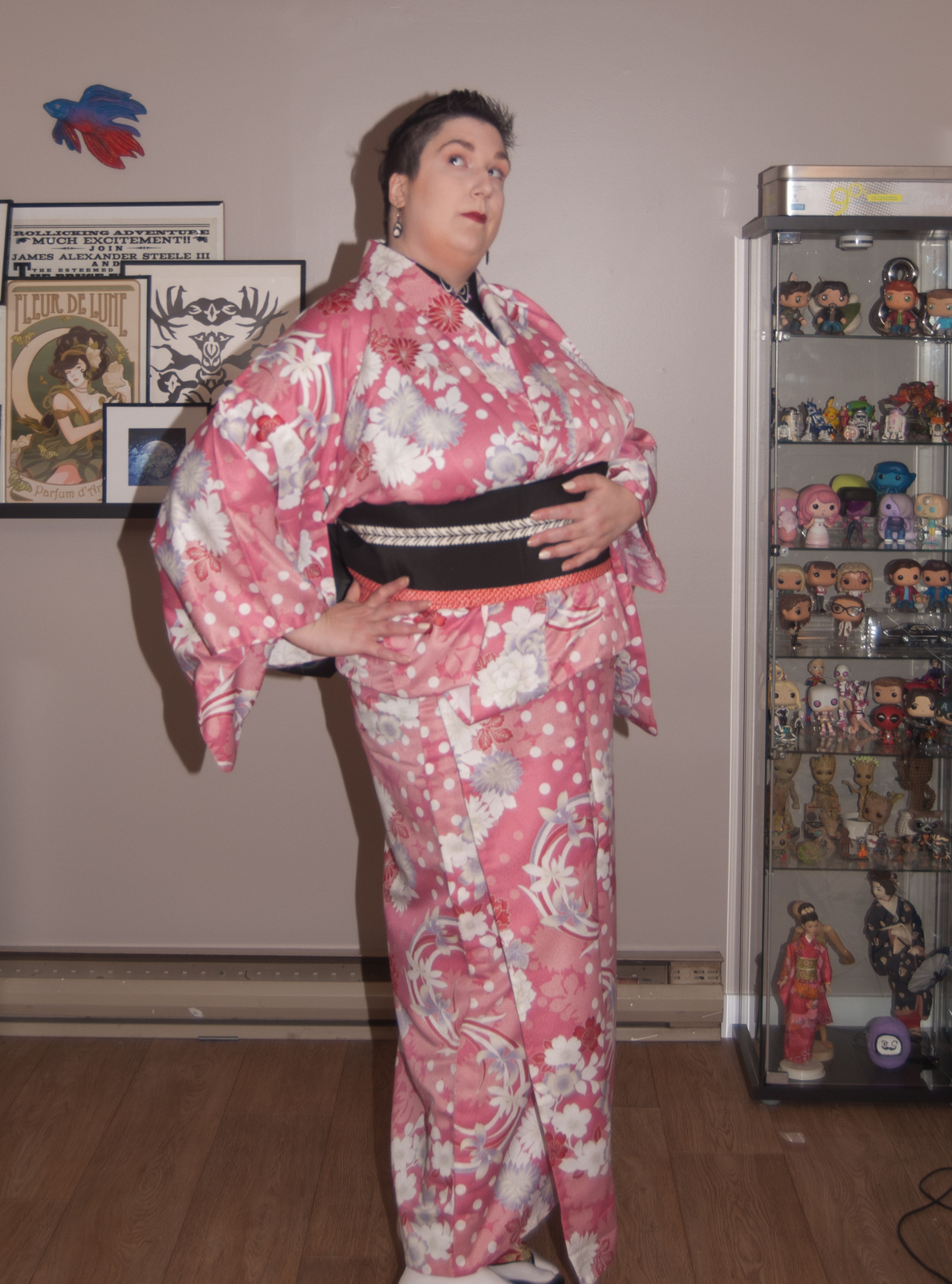
I’ll be honest, I got dressed for part of a bigger group project that I’ll hopefully be able to share with you all soon. But I figured while I was all done up I should take advantage of it. Also, you get to see part of my bedroom for once, instead of the living room. It’s a fair bit more boring, but I wanted a more neutral background. So not only do you get to see my goofy face, you get to see a small part of my ridiculous pile of collectables. I’m sure you’re thrilled.

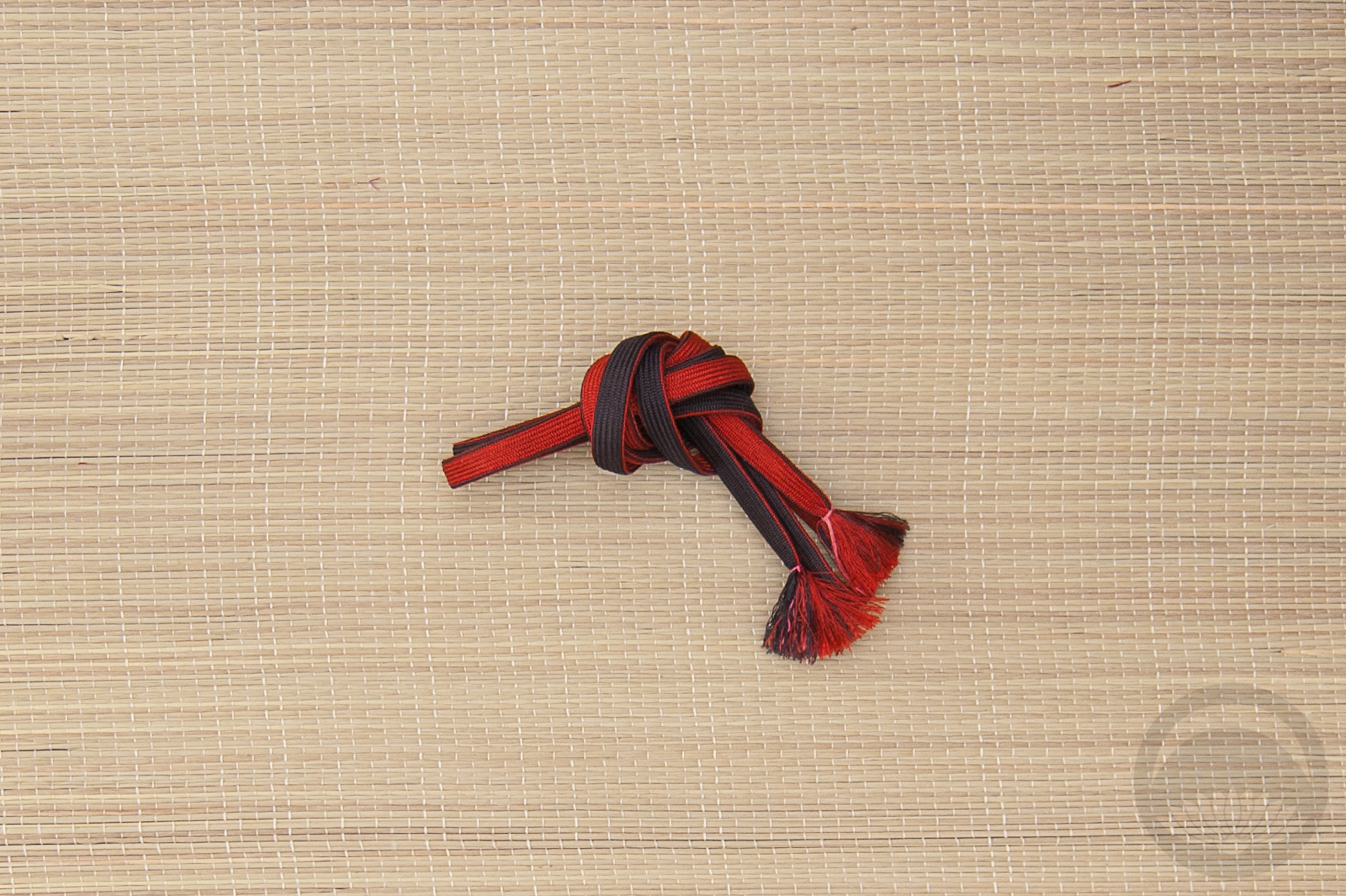
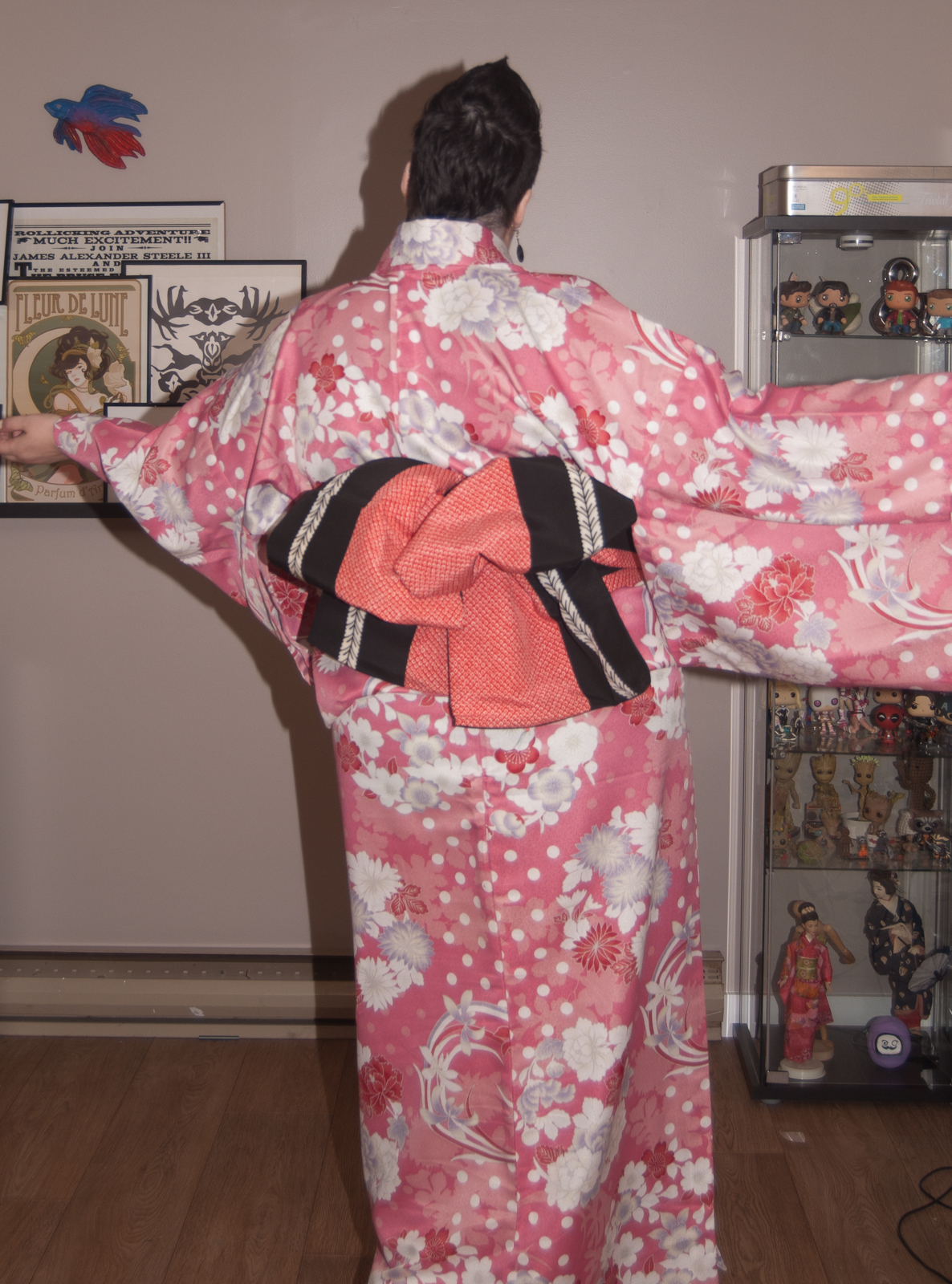
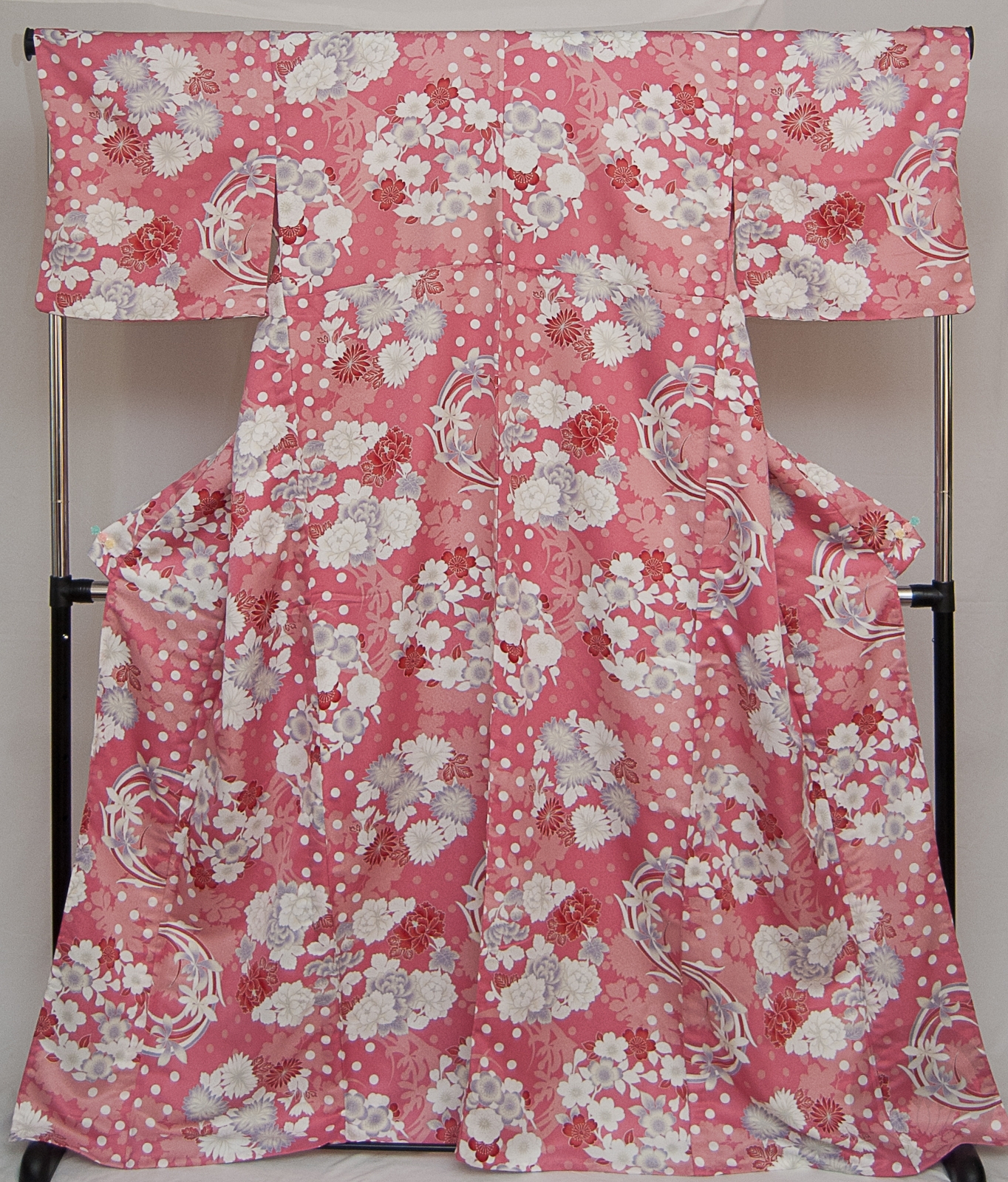
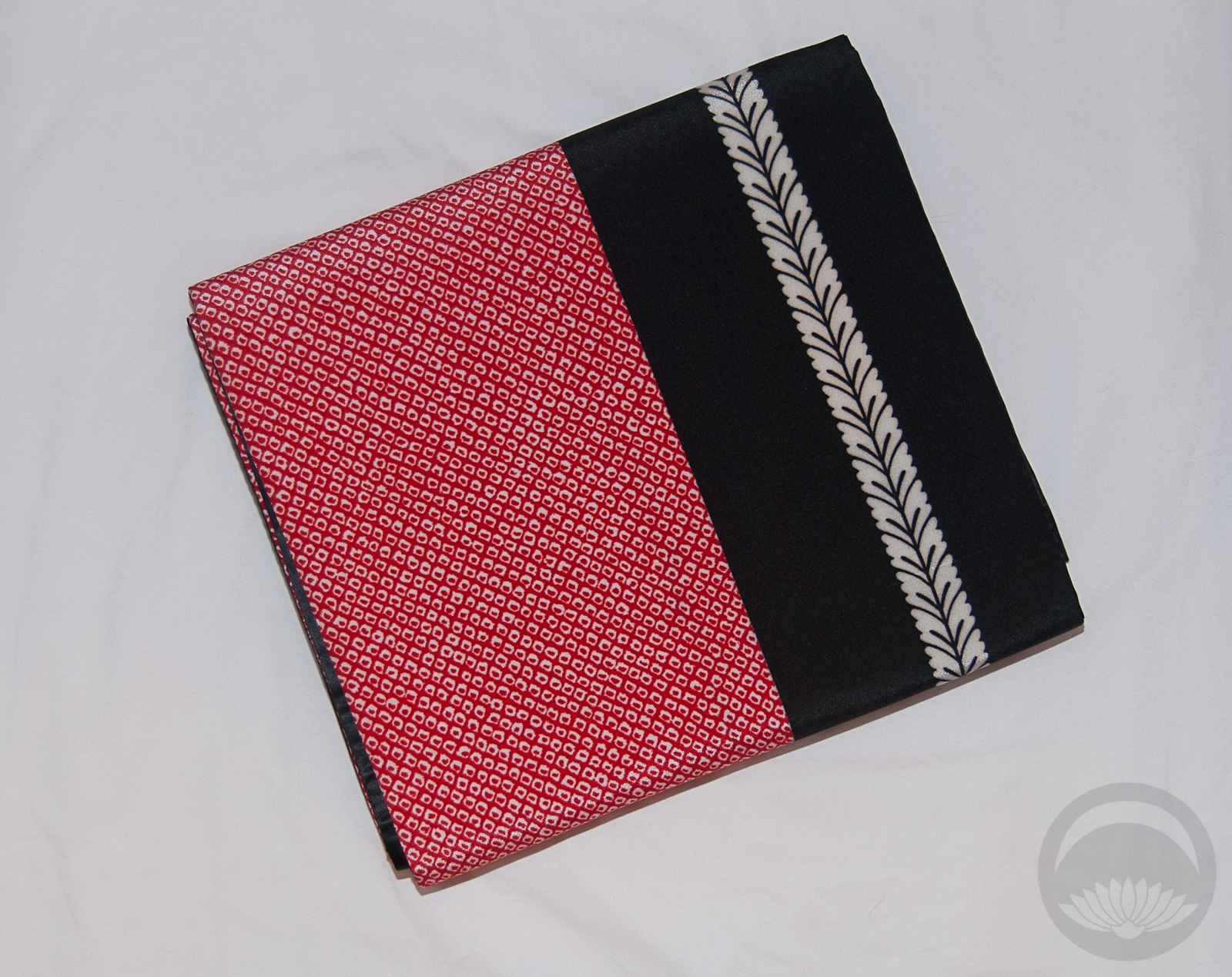
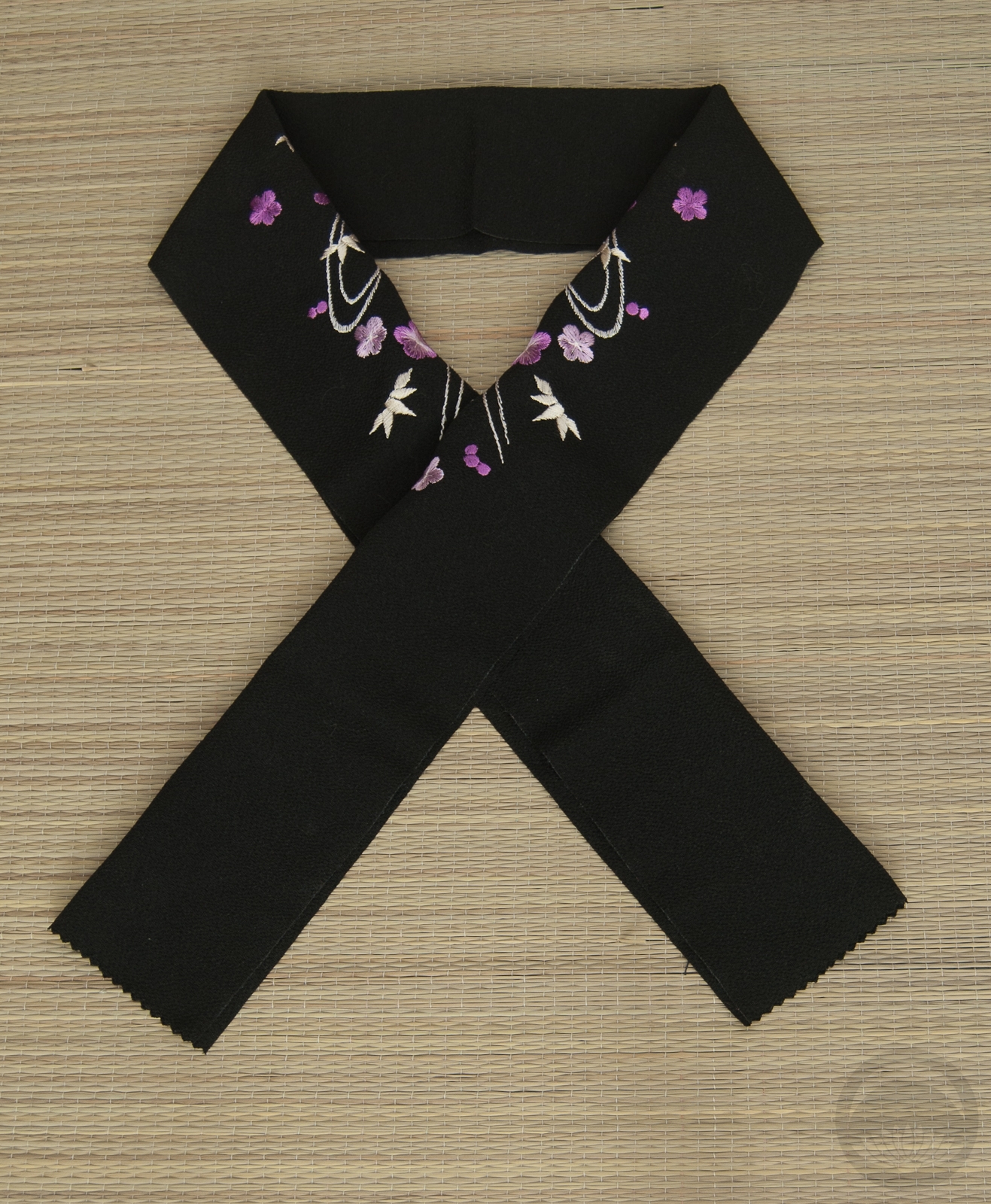
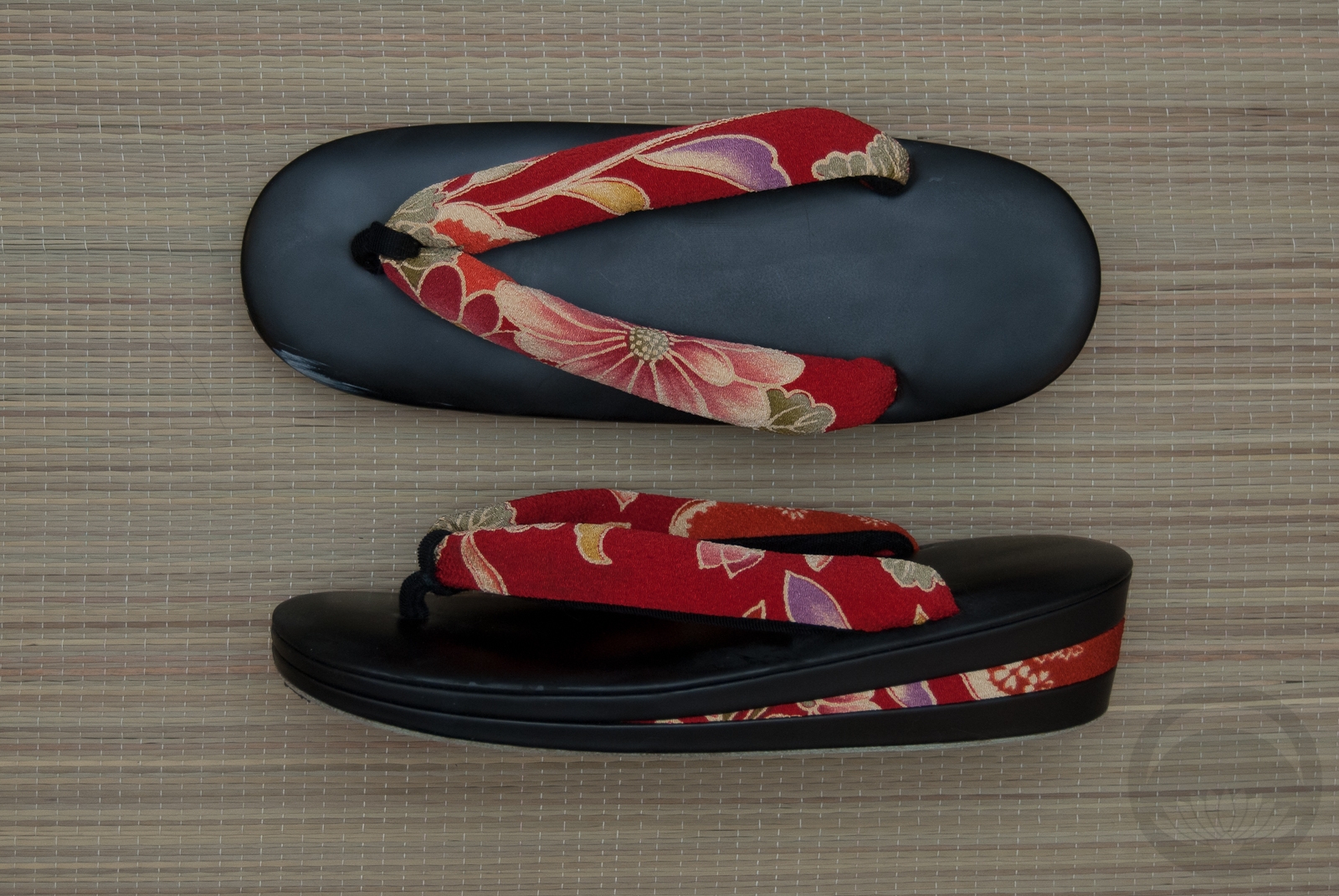
I really do love these giant kimono from Kimonomachi. Unfortunately, Rakuten Global has shut down so ordering from Canada is way more of a hassle now than it used to be. I decided to pair the pink one with this awesome red and black faux-shibori obi in a sort of cute improvised casual musubi. Black haneri and black zori (which got mostly cropped from the photos, alas) help anchor the outfit and echo the black of the obi. I kept my makeup soft and pink to suit the kimono, since my hair is already edgy enough at the moment. My moonblossom kamon kanzashi earrings were the perfect finishing touch, I think.

Items used in this coordination

R is for Rinzu

Rinzu, 綸子, silk damask

Rinzu is like jacquard, a beautiful tone-on-tone pattern achieved by weaving techniques only. No dye, no paint, just right off the loom with a rich, beautiful depth.

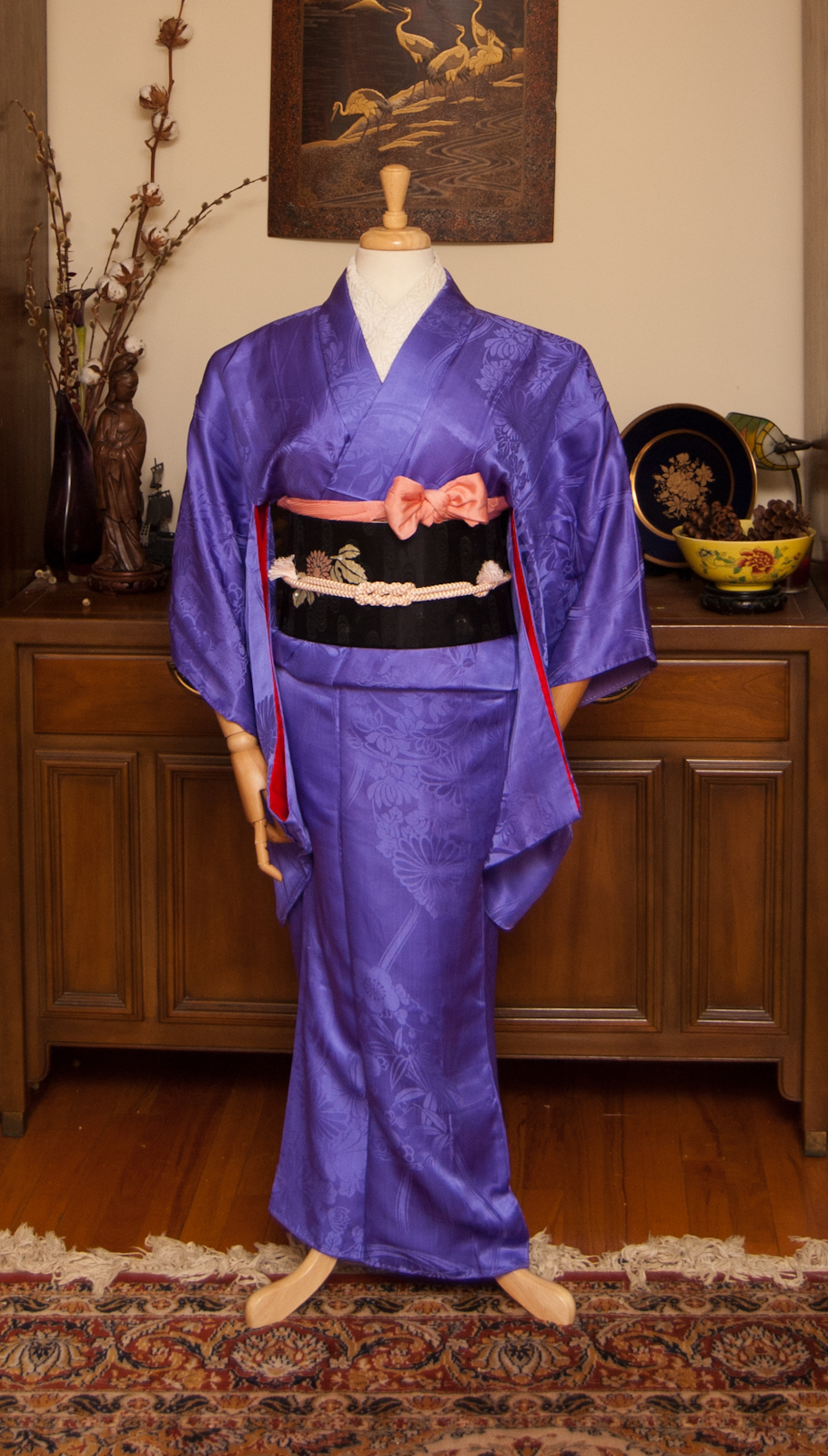
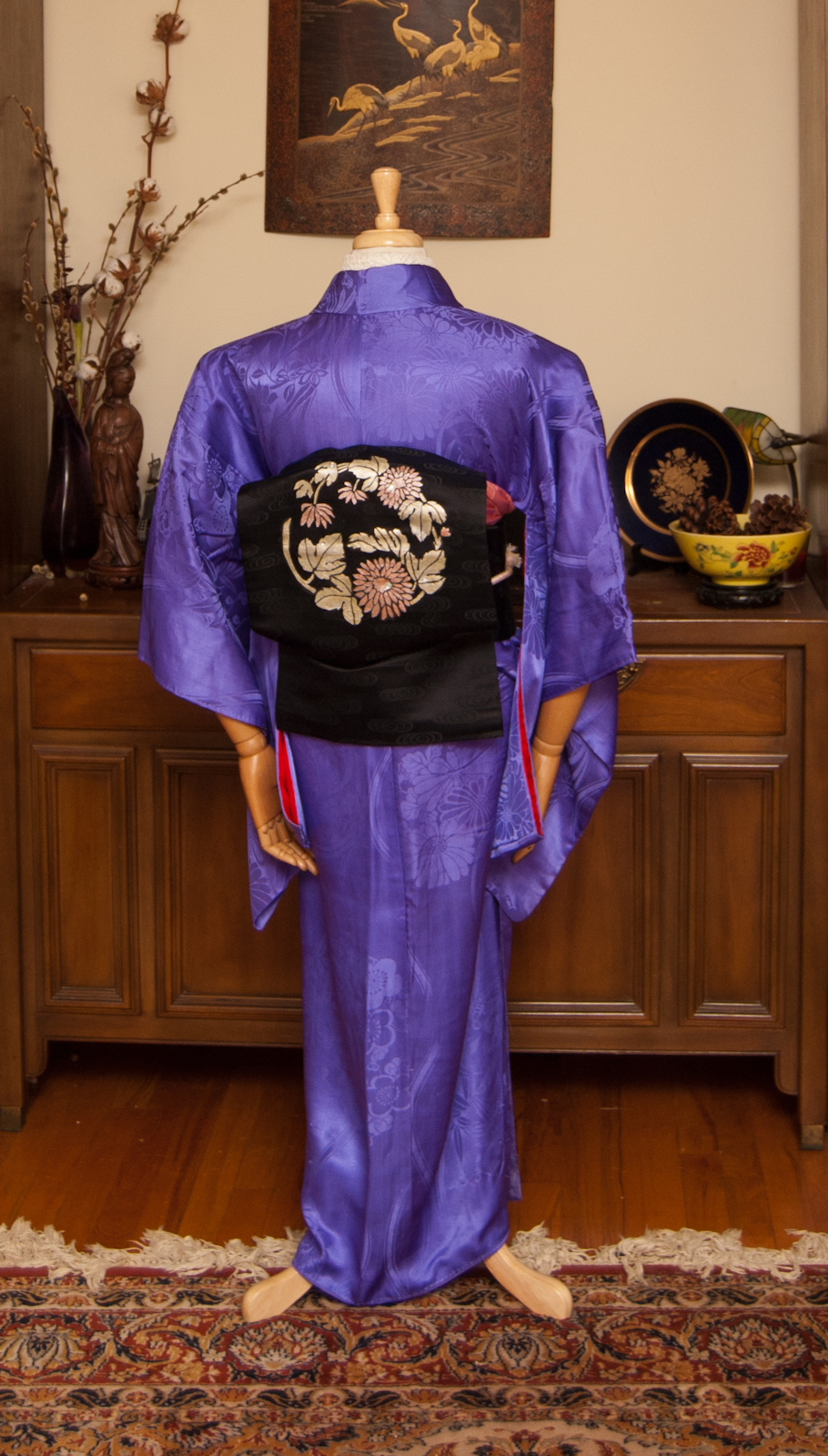
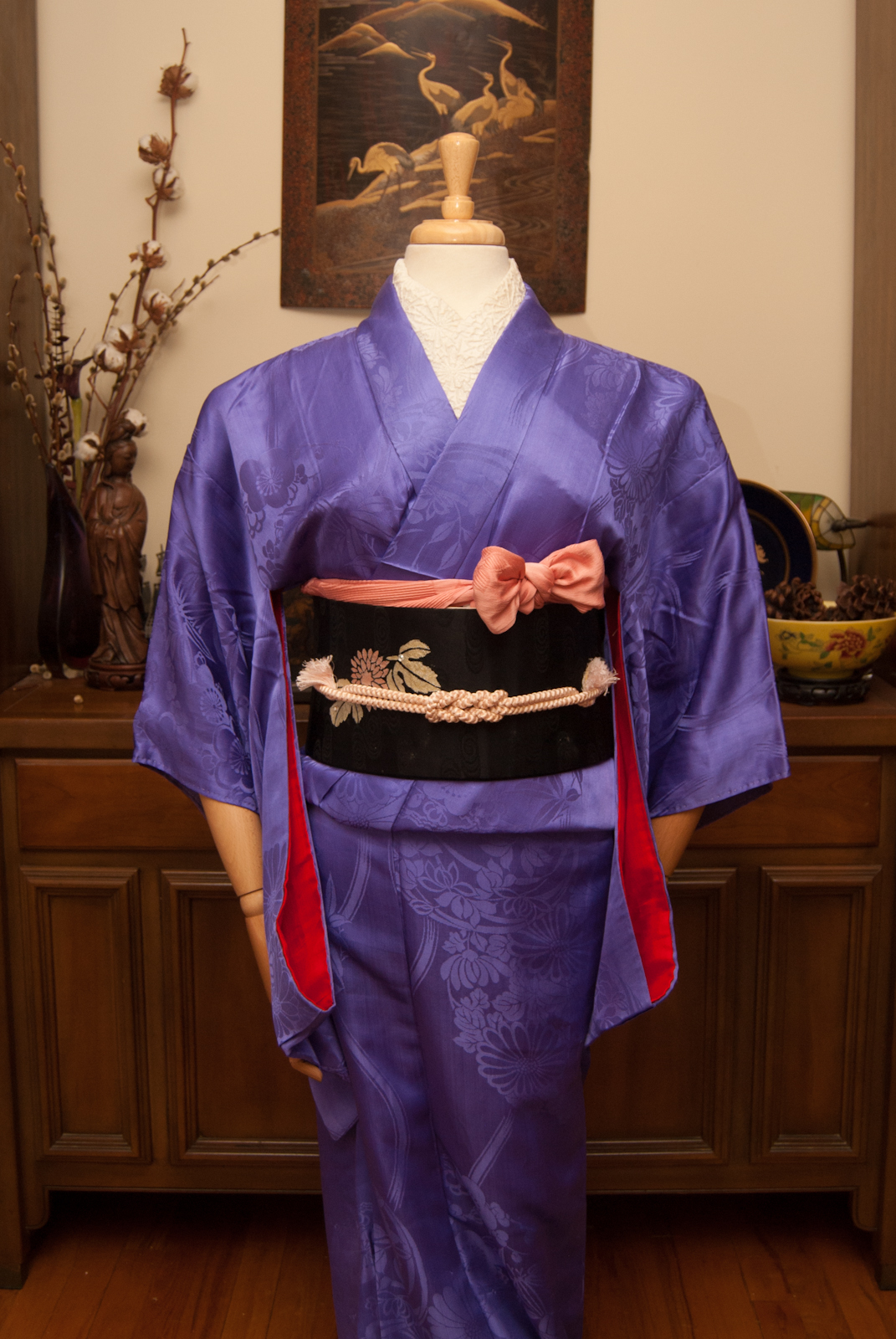
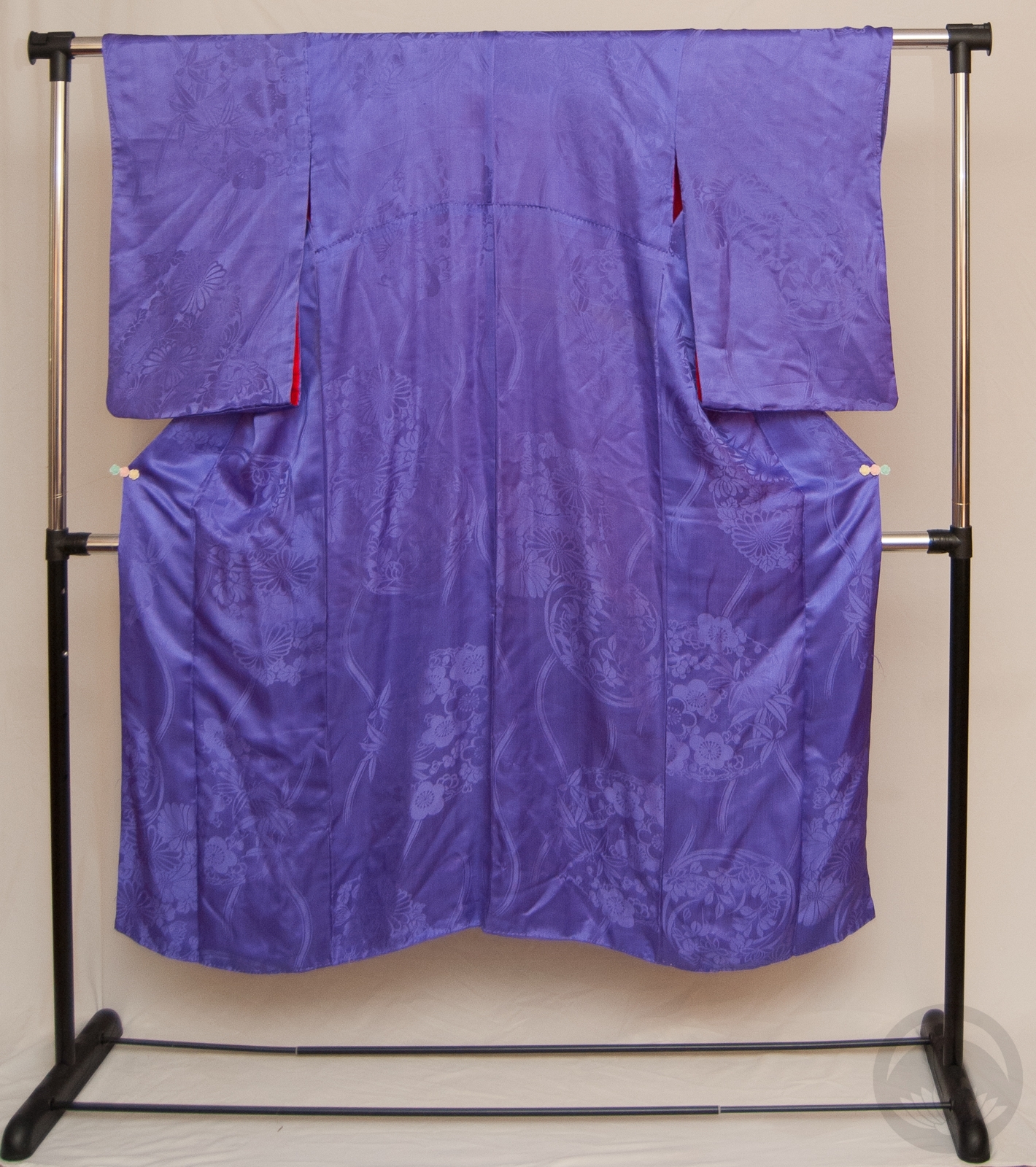
I have lots of pieces in my collection that have a rinzu base, but none of them show off and exemplify them quite as gorgeously as this vintage purple iromuji given to me by a friend. I decided to do an entire outfit (or as much as possible) using only solid pieces with bold rinzu fabric.

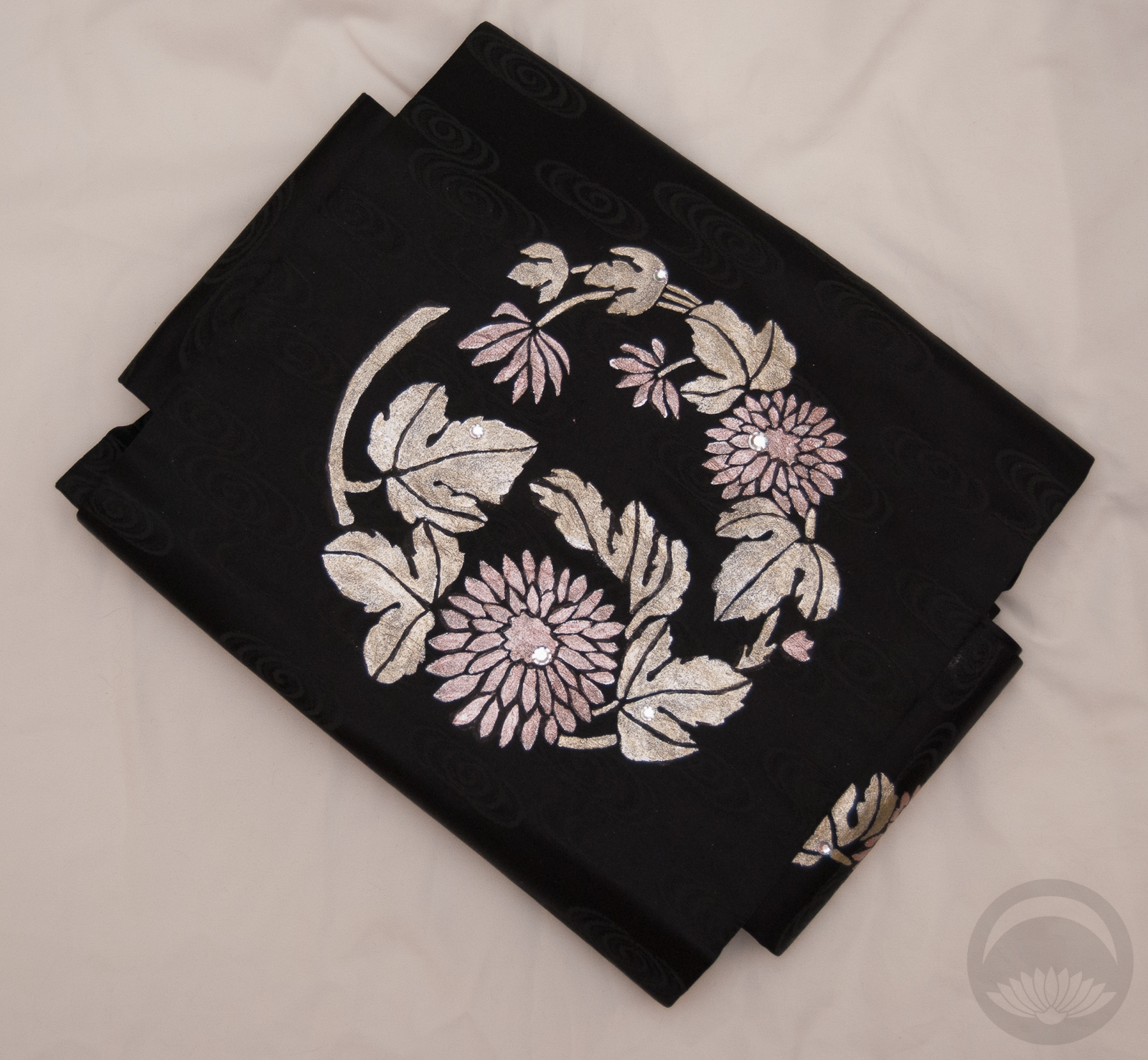
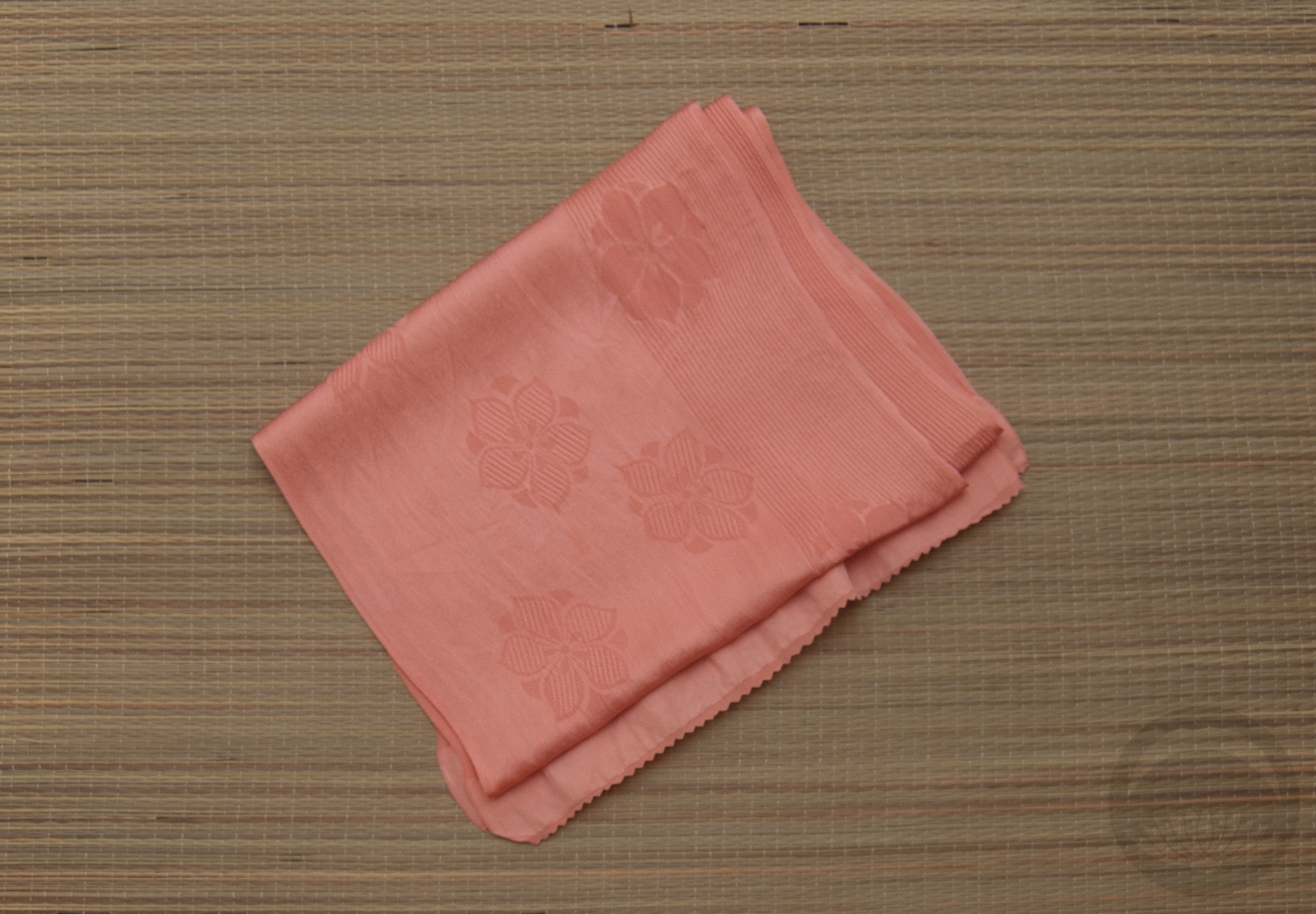
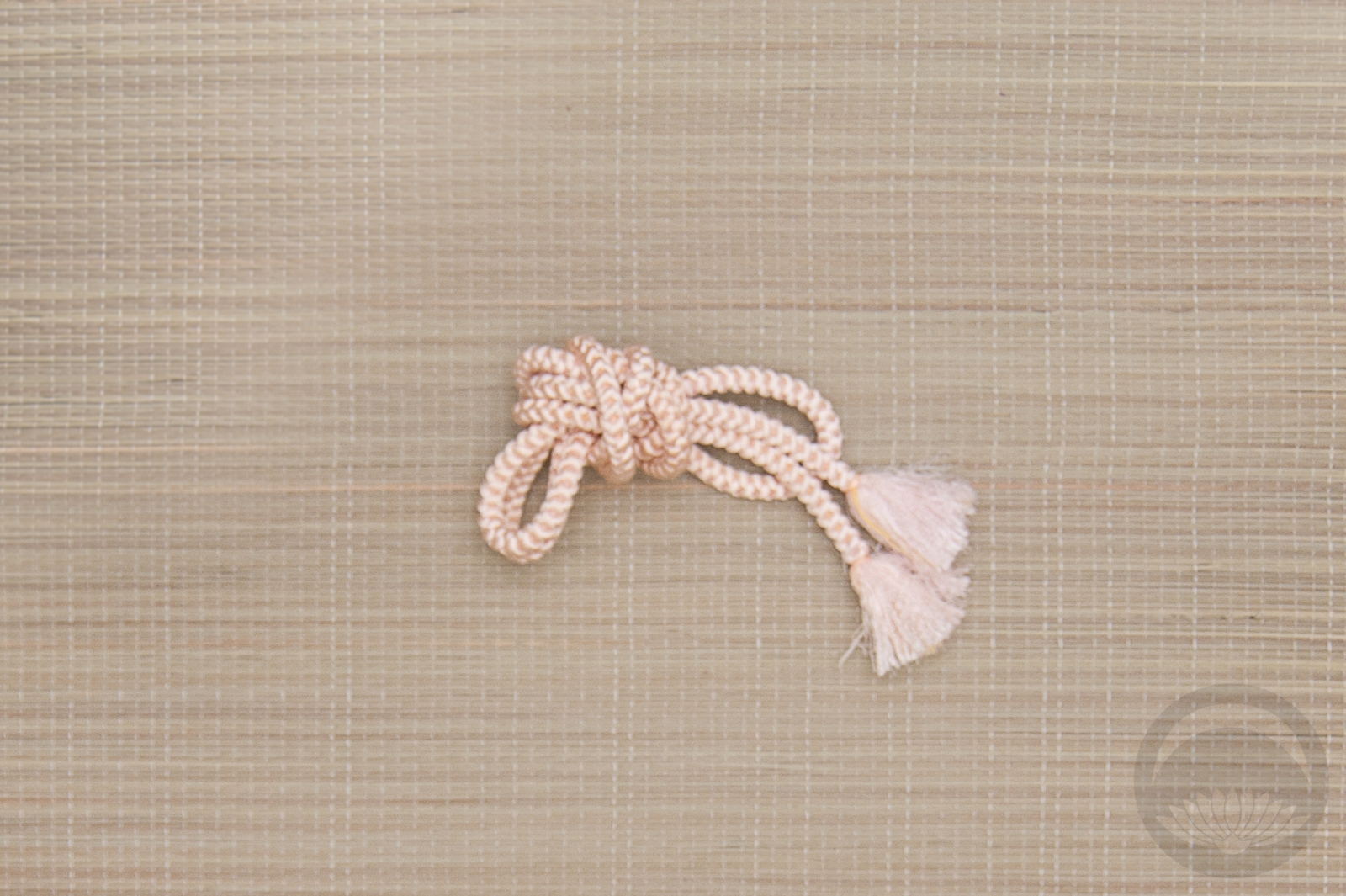
Aside from the utterly lush purple kimono, I used the mofuku obi I painted a while back, since you can still see the lovely water pattern in the black fabric. The obiage is a soft pink that ties in well with the obi, with a rinzu design of sakura and geometric lines. I tied it in a little bow for more sweetness and softness. I’m honestly not sure if the haneri counts as rinzu, the weave is much more textured and raised than anything else I own. But the design is woven, not painted or embroidered, so I ran with it. As for the obijime, the only rinzu one I own is an all-black mofuku piece, which felt too heavy against the black obi so I just went with a soft pink round braid.
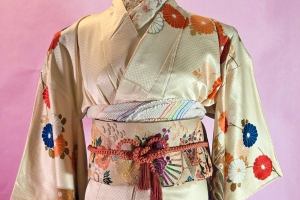
The outfit is quite simple, but I think it does a fantastic job of showing off all the gorgeous woven design and texture that is rinzu silk!

Items used in this coordination

P is for Patapata

Patapata, パタパタ, onomatopoeia of “fluttering wings”

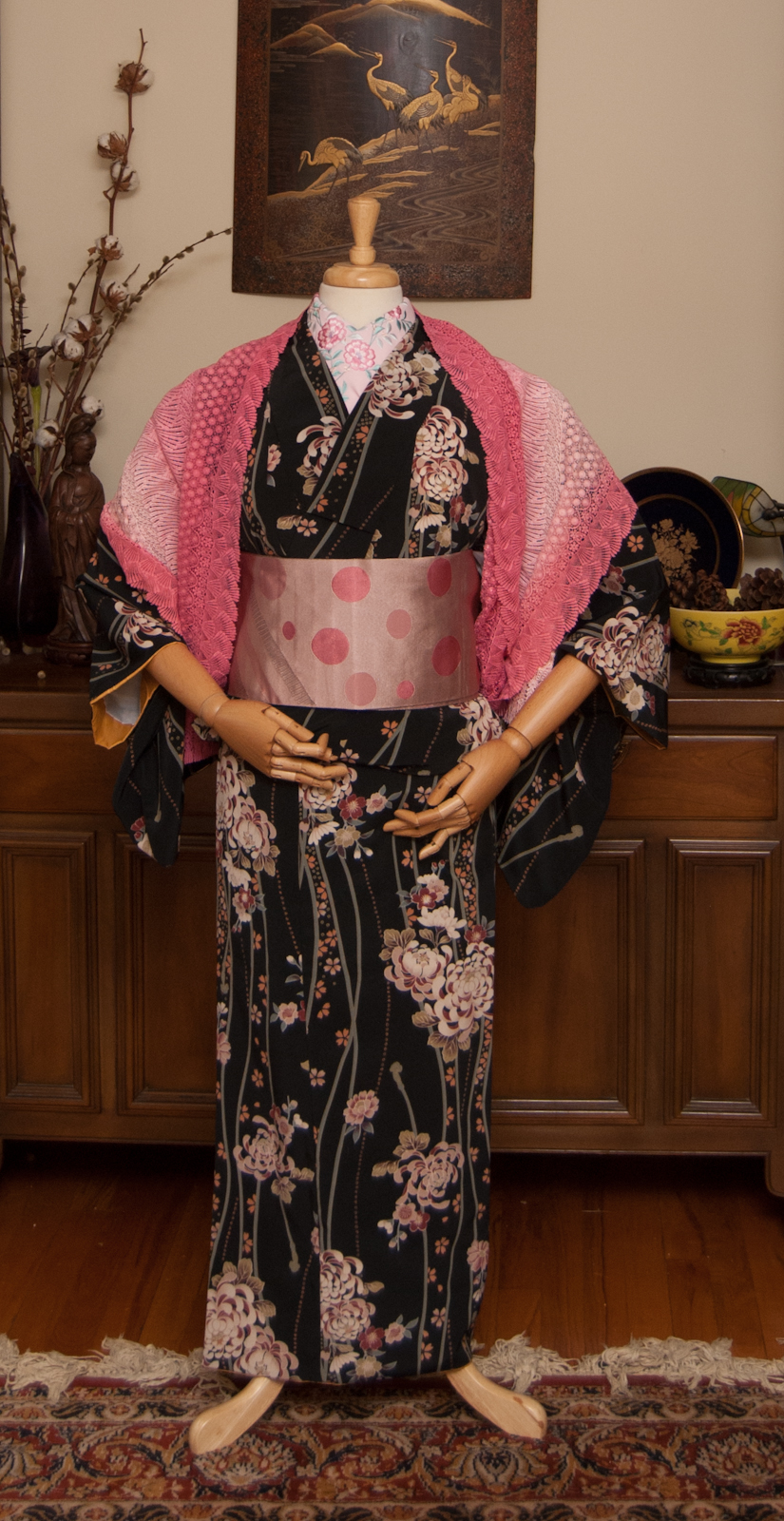
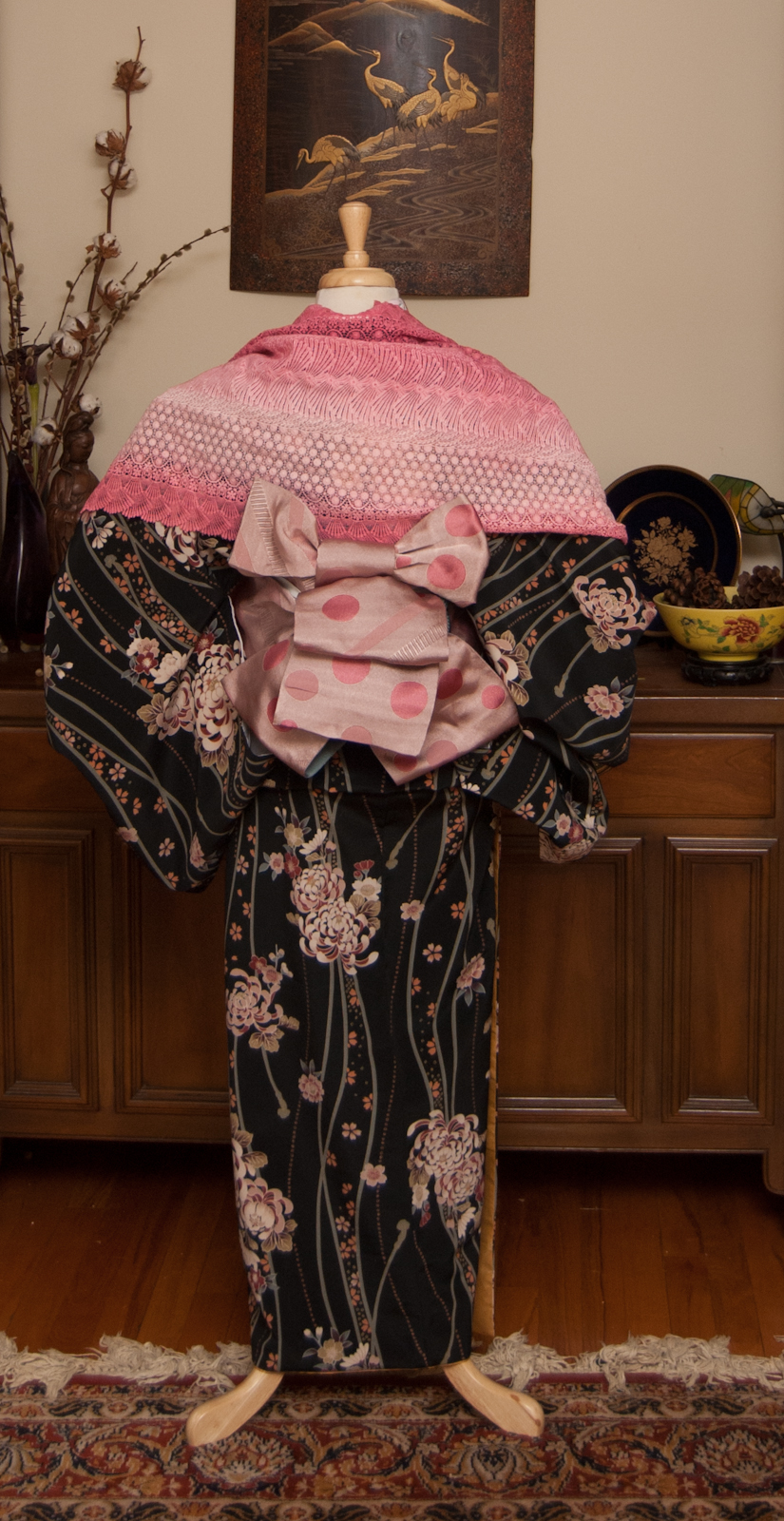
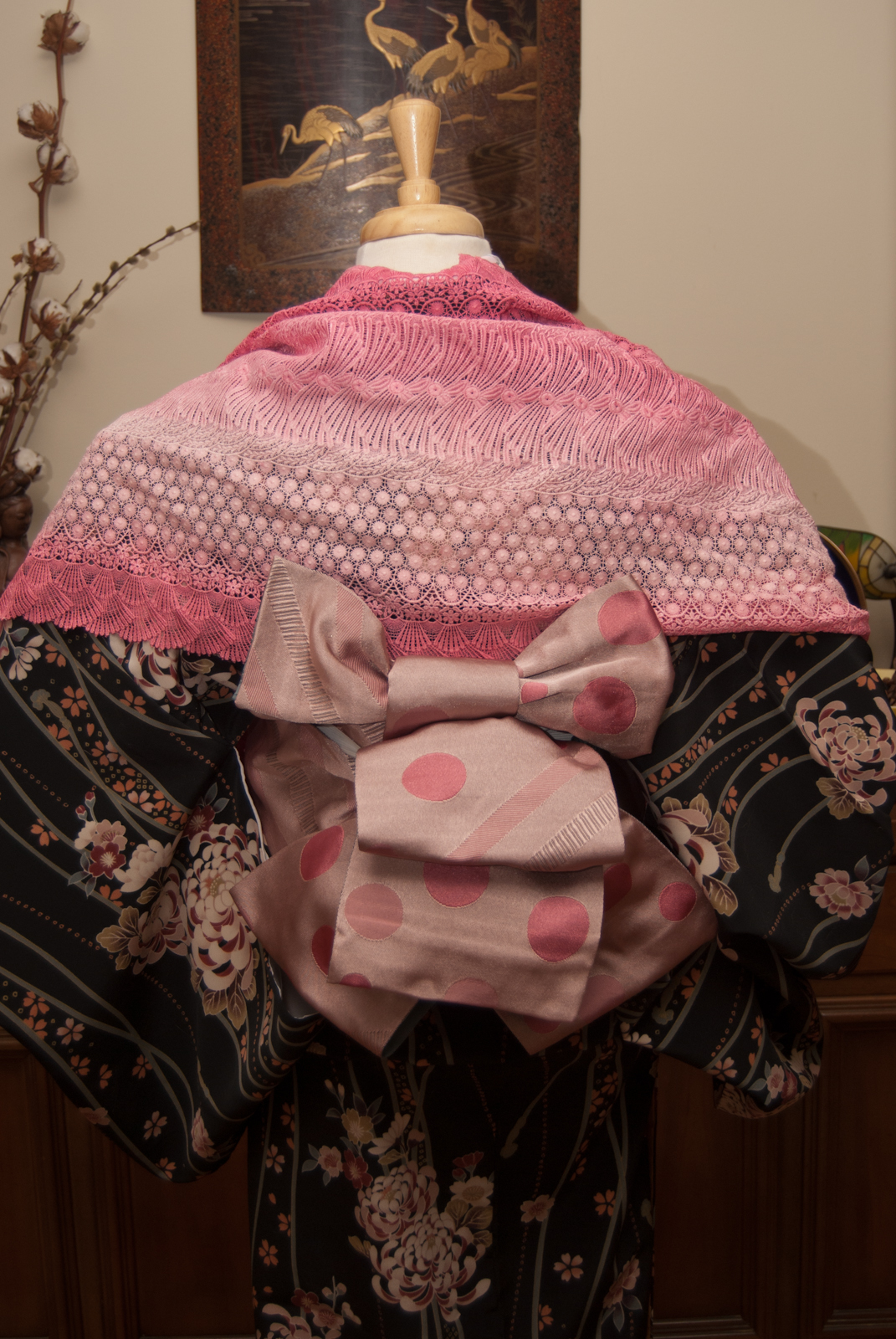
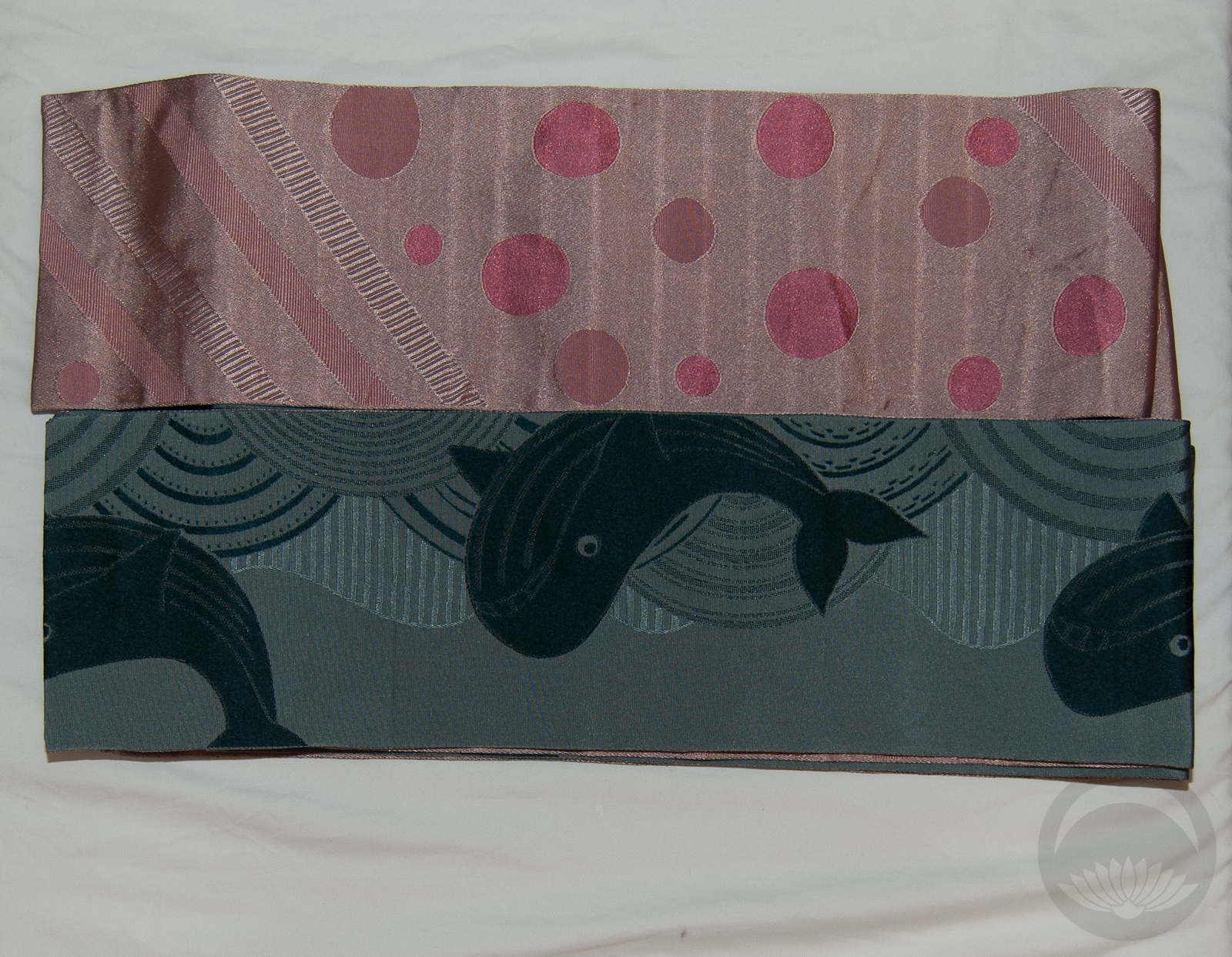
Ever since I saw this tutorial for an adorable patapata musubi with a bow accent, I knew I wanted to try it. I kept procrastinating for some reason, but now I’m glad I did because that means today I can show you this perfectly puffy pink patapata coordination! Japanese is a language full of adorable onomatopoeia, and patapata represents the fluttering sound made by bird or butterfly wings, and looking at the soft blousy folds it’s easy to see where the name came from.

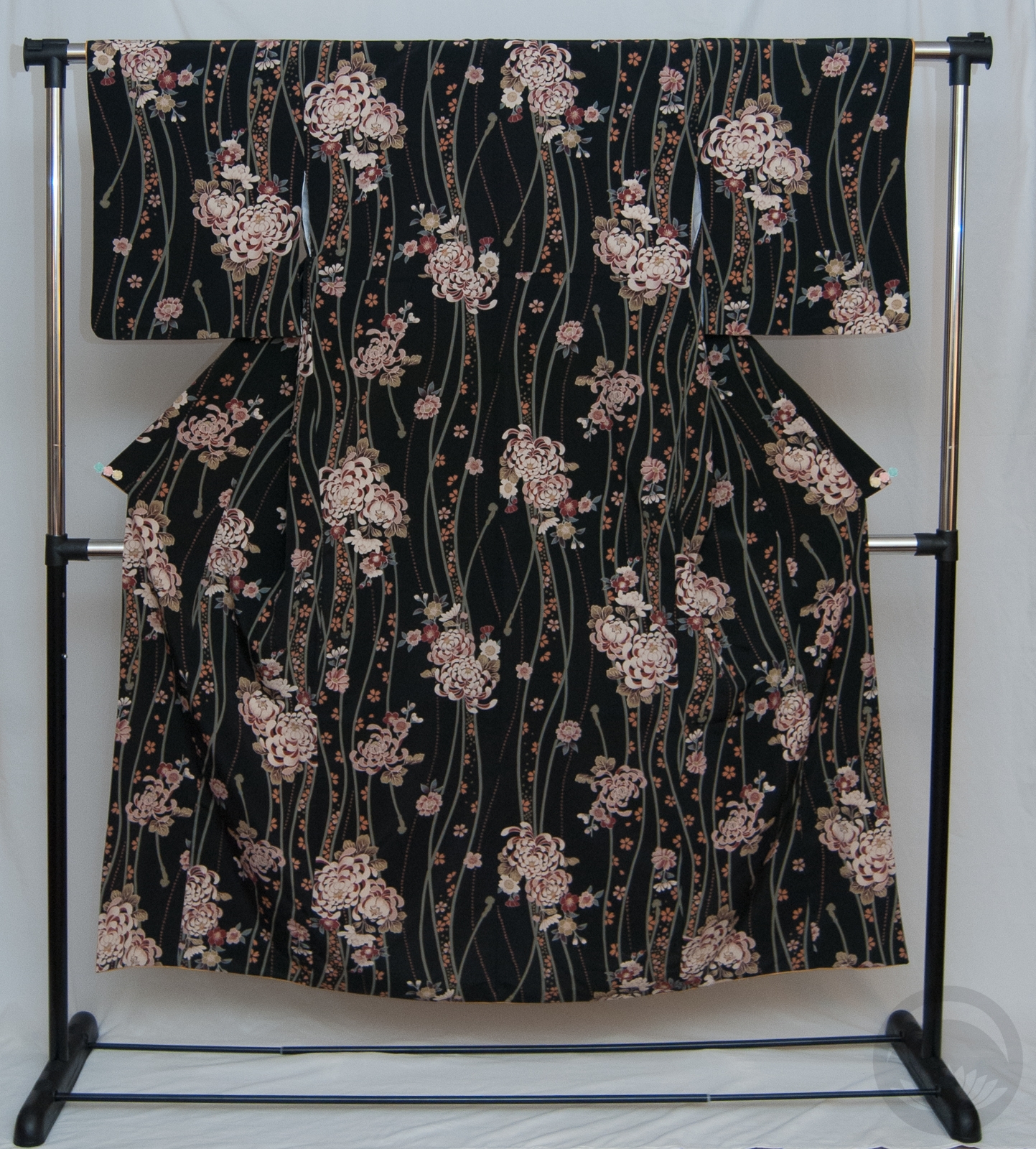
I used the pink bubble side of my adorable whale obi, along with a sweet multi-floral black komon kimono. The outfit felt a little too boring as-is, so I pulled out a bright pink haneri and lace shawl to complete the look while making sure nothing distracted from the adorable obi bow.

If you’d like to learn to tie patapata musubi yourself, here is the video I followed! I love Sunao’s videos, they’re very clear and the English subtitles are very well-written.

Items used in this coordination

C is for Chidori

Chidori, 千鳥, plover

Since today’s feature is about everyone’s favourite goofy little bird motif, chidori, I had two obvious choices for this entry. My bold, high-contrast irotomesode with nami-chidori (plovers on waves) around the hem, or the quieter but more unusual kurotomesode with tiny chidori over stylised matsu (pines).

The subtle, small chidori won out in the end though. I really love this kimono so much, for several reasons. It was purchased in Boulder, Colorado, which is a place that means a lot to me, and it’s also a rarity since there was only a brief period where it was acceptable and stylish for kurotomesode to have a small amount of motif on the back of one sleeve. As much as I love the showier irotomesode, this piece below will always have my heart.

I paired it with a tsuke-obi that also has pine motifs and went for accessories all in the same sort of warm green/brown colour scheme. It’s a very subdued and harmonious outfit, which appeals to me more and more as I get older.

Since “chidori” is also the term used for herringbone patterns, I debated using this obidome as well. You can see where the name came from, the little interlocking shapes do indeed look like the stylised shape used to represent the birds. But it felt too modern and casual for the rest of the outfit, and didn’t fit over the obijime I’d chosen, so I’ll save it for another time 🙂

Items used in this coordination