From the Archives – Hydrangea ro komon

Unfortunately, life’s been both hectic and humid here lately and I haven’t had many opportunities to wear kimono. Hopefully the pictures of new items and book reviews and whatnot have been interesting to you guys. I am really enjoying the book reviews and I’m really hoping to do more in the future. However, this is afterall a kimono blog and it’s about time I posted some more pictures of outfits!

These pictures are actually quite old, from when I first got the outfit, nearly two years ago. However, they are of my first (and only!) ro summer weave outfit, so I figured they might be worthwhile to share at this time of year! I was saving them because I had planned to wear this outfit again to an art exhibit I attended recently (I will be posting an entry about that soon, don’t worry!) but unfortunately the weather wasn’t cooperating, nor was the knee I injured a few days beforehand. I ended up wearing a haori with jeans and a nice top. Boo.

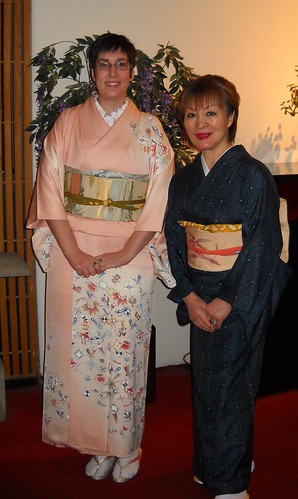
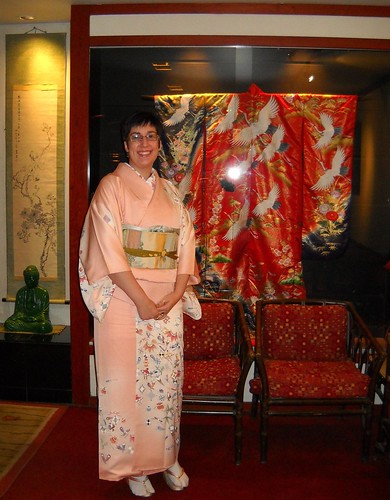
The kimono itself is a deep navy, with bright white and pink hydrangeas printed all over. The obi is cream and hakata weave. When I bought it, I thought it was white, but the cream is a nice contrast against the navy. The accessories are a soft pale pink, to tie in with the hydrangea. I have also since bought a pair of pink lace tabi to wear with this outfit, but have no photos yet.

Please forgive the excessive amount of bosoms going on in this outfit – at the time I was using a bright lime-green rubber datejime to flatten my bust, and there was no way of hiding it under the kimono, since it’s semi-transparent. I had to do without, and this is what the girls look like when not sufficiently strapped down.

Montreal Matsuri Japon 2010

I went to the annual Matsuri Japon last year and really enjoyed it, so when I found out it was happening again this year I was eager to head out. I wore my black ume yukata and blue and white hanhaba hakata obi to work all day, and after my work day was over my mother joined me and we drove down together. Since there are so many photos here, I’ve put smaller versions than usual in the post, please click on them to see bigger versions 🙂

Unfortunately, the festival had changed locations this time around, and it was in a much more cramped location in the middle of the busiest and most tourist-filled area of the Old Port of Montreal. The traffic flow was not ideal and the stage where the taiko drummers were was virtually impossible to get to. I was a bit let down. However, there were plenty of lovely yukata to see and photograph, and a few great bargains to be had.

At first I didn’t realize that the festival had moved, so I tracked down a guide and asked them where to go. This lovely gentleman then came up to me and asked me where to go, he was as confused as I was! After posing for a photo at my mother’s insistence, we headed off to the new area together.

At the gate, I saw the always-radiant Akane, who I generally run into at these sorts of events. She’s such a sweetheart.

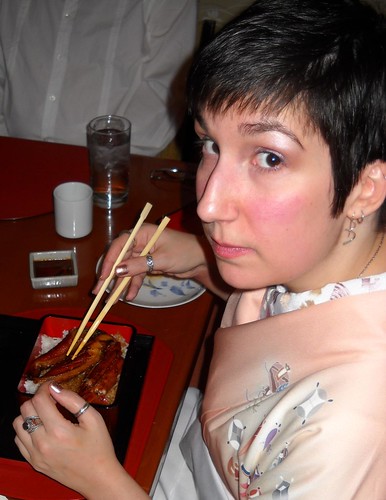
And in the long-standing tradition of goofy photos of me with food in my mouth (if you have me on Facebook you’ve probably seen some others) I found some takoyaki! It was yummy.

This lovely young woman had the most luscious raspberry-red yukata with great shibori all over it, and a really pretty obi with some urushi-like flowers on them, she looked great!

Another beautiful young woman who was doing custom calligraphy.

She made me a very nice interpretation of Tsuki and Hana (moon and flower), on some beautiful Japanese paper.

Three little dolls looked absolutely adorable in their yukata and heko obi! Love the hats, too.

A beautiful family! The young boy on his daddy’s shoulders had the cutest “Chip & Dale” jimbei!

There was not much in the way of kimono to purchase, thankfully. However, I did manage to find some very cute obijime for a steal, $5 each!

And I couldn’t pass up this adorable origami crab jewelry! I will probably turn the pendant into some sort of obi-kazari, as I always wear one of my pearl necklaces, but I couldn’t pass it up!

There are plenty more pictures in my Flickr Account, if you’d like to see! I’d also like to give a huge thank-you to my mom for taking a lot of these photos!

Black Hanamaru Furisode

Black Hanamaru Kofurisode

This is a piece I’ve already shown you, I wore it the first day it arrived, but it also needs a decent catalogue entry, so please bear with me.

Yamatoku was having a sale over the summer of graduation kofurisode overstock. Kofurisode are shorter-sleeved furisode, typically worn with hakama. Girls often wear them during high school and college graduation, so about a month after graduation season, kimono retailers will typically have a large number of modern, synthetic, mass-produced kimono available for good prices.

I don’t usually like modern kimono, and furisode even less, so I honestly wasn’t expecting to pick one of these up. However, when I found this one I had to cave in. It’s komon-style (all over pattern), so it doesn’t scream “furisode” to me. If anything, between the sleeve length and the bright all-over pattern, it looks more like a vintage everyday kimono than a modern graduation outfit. Because it’s modern, it’s nice and large and actually fits me nicely. It was also a steal at $19.95. How could I say no?

The patterns are hanamaru, which are decorative balls of flowers. They’re primarily fall and winter flowers; ume and kiku. There’s also some sort of berries or tiny flowers, I have no idea what these represent. If you know, please comment and help me out! There’s also some subtle trellis designs which add a nice geometric element and keep it from feeling too twee or girly.

The hakkake is a deep yellow, and there is a matching built-in kasane-eri. I hate those damned things, but it does add a nice vibrant touch of colour up by my face, and helps to break up the black, so I’ll probably leave it in there.
Hanamaru Kofurisode; in which I am a moron

It’s 32 degrees out (90 F). So what do I do, as soon as I come home and find my brand new lined synthetic kofurisode in the mail? Lovingly admire it and fold it away for cooler weather, like a sane person would? Of course not! I decided to coordinate an outfit and put it on ASAP.

I decided to pair it up with my pink and white hakata obi. This thing is like cardboard! It was a huge pain in the posterior to tie, but once I got it, it totally stayed put, which was awesome. I used my hellow shibori obiage and hakata obijime, to go with the yellow kasane-eri that was already built into the kimono. Some purple tabi tied in well with the flowers. My Aikoku Fujinkai obidome was the perfect finishing touch, it almost looks like it was made for the kimono.

And of course, my big orange lug insisted on making an appearance.

I really love how the whole outfit turned out, and I will definitely wear it out, possibly on my birthday in November when the lining and the motifs all make more sense with the weather!

Shifuku and Usagi Houmongi

If you’re a regular reader of my blog, you’ve technically already seen this particular kimono, when I wore it out to the park (and then subsequently dinner, but I did not take photos of that) a few weeks back. I finally had some time to take proper catalogue photographs, and it’s a piece that really needs to be appreciated in detail.

The kimono is a subtle pastel gradient. I honestly did not even notice the gentle lavender at the shoulders until I hung it up to take the reference photos. The gold is also really soft and gentle. I don’t typically like large areas of gold leaf on a kimono, but on this one it’s not in-your-face.

However, the real magic is the embroidery on the front panels. I was informed that they are shifuku, or silk pouches used to protect items used during tea ceremony. The embroidery is done entirely in french knots, a technique known as saraga nui. I cannot imagine the time, patience, and skill required to do this.

The most special shifuku in my eyes is by far the one with the adorable white rabbit on it. It’s the sole reason I bought the kimono. He’s just so charming and quirky, on what is otherwise a very subdued and mature kimono.