Black Hanamaru Furisode

Black Hanamaru Kofurisode

This is a piece I’ve already shown you, I wore it the first day it arrived, but it also needs a decent catalogue entry, so please bear with me.

Yamatoku was having a sale over the summer of graduation kofurisode overstock. Kofurisode are shorter-sleeved furisode, typically worn with hakama. Girls often wear them during high school and college graduation, so about a month after graduation season, kimono retailers will typically have a large number of modern, synthetic, mass-produced kimono available for good prices.

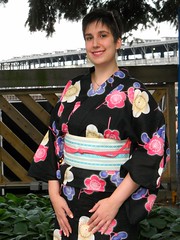
I don’t usually like modern kimono, and furisode even less, so I honestly wasn’t expecting to pick one of these up. However, when I found this one I had to cave in. It’s komon-style (all over pattern), so it doesn’t scream “furisode” to me. If anything, between the sleeve length and the bright all-over pattern, it looks more like a vintage everyday kimono than a modern graduation outfit. Because it’s modern, it’s nice and large and actually fits me nicely. It was also a steal at $19.95. How could I say no?

The patterns are hanamaru, which are decorative balls of flowers. They’re primarily fall and winter flowers; ume and kiku. There’s also some sort of berries or tiny flowers, I have no idea what these represent. If you know, please comment and help me out! There’s also some subtle trellis designs which add a nice geometric element and keep it from feeling too twee or girly.

The hakkake is a deep yellow, and there is a matching built-in kasane-eri. I hate those damned things, but it does add a nice vibrant touch of colour up by my face, and helps to break up the black, so I’ll probably leave it in there.

From the Archives – retro-style wool komon coordination

Okay, this is kind of a cheat. This is an outfit I wore quite some time ago, but I quite liked how it turned out. It’s murderously hot out, so I thought maybe an outfit for the fall would remind me of the lovely crisp weather in early spring, and cool everyone down.

It’s all over the place formality-wise, and not really correct with the gloves and boots, but I was going for an overall look, feel and style here, not perfect Sodo kimono regulations. I was aiming for a sort of subdued 20s style, and I think I kind of pulled it off. I’d love to wear some sort of little cloche hat with this, but I look like a total doofus in any sort of hat so let us never speak of that again.


I paired up my great black, white, and red wool komon with my red tsuke-obi and red synthetic haori. A green kasane-eri, green shibori obiage, and round green obijime hold everything together and add a bit of pop. See what I mean about mixing formality? For those of you who aren’t familiar with the rules, I’ve put cocktail-level formal accessories with a “running grubby errands” kimono. And then, if that wasn’t enough, I’m wearing high-heeled black leather boots and black opera gloves! The scandal!

Items used in this coordination

Traveling down the Tokaido Road

This is an entry that’s been a long time in coming. It may get a bit verbose, and I apologize. If you’re not interested in personal ramblings and art-related discussion, feel free to skip it.

My interest in kimono stemmed from an interest in traditional Japanese aesthetic in general, which I believe I inherited from my grandmother. I have always been fond of traditional woodblock prints; landscapes in particular.

The Tokaido Road is a highway connecting the New Capital, Edo (tokyo), with the Old Capital, Kyoto. There are 53 famous way-stations along this road, plus the start and end points. Edo-era artist Hiroshige Ando became so enamored of the views of these stations that he produced several series of prints, known as the “Stations of the Tokaido“. There are four editions of these, each from slightly different vantage points and during different times of year. The most famous, however, is the Hoeido Edition, and is the one I will most often be referencing here.

About a year ago, I found an obi on Ichiroya of a snow-covered cabin in the mountains. As soon as I saw it, I felt an immense pull and a desperate desire to have it. As I’ve mentioned before, my best friend lives in Colorado, and I often go visit him (sometimes buying kimono while I’m there), and I initially chalked the nostalgia the obi made me feel to my love of the mountains there. Naomi‘s darling husband Arian took pity on me and my obsessive infatuation, and bought me the obi as a gift.

The more I thought about it though, the more visually and emotionally familiar it felt. It took me a while, and a great bit of help from Erica, it finally hit me. It was a creative interpretation of Station 15, Kambara, with the people removed.

This discovery, unfortunately, created a torrent I’ve since been unable to stop. I dove headfirst into more detailed research of the Stations of the Tokaido, mostly on the internet, but in my own bookshelves as well. I’d actually purchased books about Hiroshige years before, and one that’s always come in handy is Hiroshige In Tokyo, by Julian Bicknell. Armed with a new wealth of information and a new obsesson, I dove in. I made the unfortunate discovery that these prints are a fairly popular motif for kimono and related items – obi in particular. With that knowledge in hand, I have begun to amass a “collection within a collection,” if you will.

Since that first obi, I have acquired several more, and a decorative dance fan. My ambition is to eventually have items with all the stations on them, but that is a long-term goal for when I have much more expendable income!

I am not sure, but I believe this is an interpretation of Station 14, Yoshiwara. As always, if you have further information or can read the text on it, by all means let me know.

This one is also very special to me – I have mentioned before my love of hakata, so when I found an obi that was both hakata weave and several stations, I knew I had to have it. I saved up, and the day I was ready to purchase it, someone I know online bought it for herself. I’m not going to lie, I was devastated. Through her own kindness, and the helpfulness of Yuka at Ichiroya, the obi found its way to me. I love it to bits. It contains stations Kuwana, Mariko, and Hakone.

The last obi is another one of Hakone. I already had the hakata one at this point, but I loved the soft pastel colours on this one and it was a bargain, so I couldn’t pass it up.

The last item I currently own is not an obi, but rather a nice, solid dance fan. It has the starting point (or station 0 if you will), Nihonbashi Bridge.

I am, in fact, so obsessed with this that I am currently coveting a particular nail polish – NARS Tokaido Express. Those of you who know me well are aware that I also have a passion for doing my nails and ferreting away a huge collection of nail polishes (I have over 200 at this point). When I found this polish, I knew I had to have it! The fact that it’s a gorgeous rich espresso brown with purple and gold shimmer doesn’t help! Unfortunately, it’s an expensive designer brand and actually more expensive than several of my cheaper kimono! I will have it eventually though! Probably much sooner than the kimono-related goal.

If you would like to learn more about Hiroshige or purchase prints of his work, please check out the Utagawa Hiroshige page on Artsy.

Hanamaru Kofurisode; in which I am a moron

It’s 32 degrees out (90 F). So what do I do, as soon as I come home and find my brand new lined synthetic kofurisode in the mail? Lovingly admire it and fold it away for cooler weather, like a sane person would? Of course not! I decided to coordinate an outfit and put it on ASAP.

I decided to pair it up with my pink and white hakata obi. This thing is like cardboard! It was a huge pain in the posterior to tie, but once I got it, it totally stayed put, which was awesome. I used my hellow shibori obiage and hakata obijime, to go with the yellow kasane-eri that was already built into the kimono. Some purple tabi tied in well with the flowers. My Aikoku Fujinkai obidome was the perfect finishing touch, it almost looks like it was made for the kimono.

And of course, my big orange lug insisted on making an appearance.

I really love how the whole outfit turned out, and I will definitely wear it out, possibly on my birthday in November when the lining and the motifs all make more sense with the weather!

Home sick kitsuke time

I’ve been wanting to put this outfit on for a while, since I bought the haori on my birthday and today I was feeling under the weather and didn’t go out, so I figured it would be a good time to see how it all looked together. BIG MISTAKE. Kitsuke and a fever do not mix, especially not when the obi is made of the skin of Satan himself. This obi is beautiful, but it’s synthetic and brand new, which means it’s both very stiff and very slippery. It would not stay put, and I ended up cheating on the obi a bit, since I knew I was not going out today.

Overall I am very pleased with the coordination of this outfit. It’s almost as though the haori was made specifically with this in mind.  I pulled out the pinky pastel tones with a pink obiage and pink and silver obijime, and then tied it all together with silver zori. However, my kitsuke (and the look on my face in the photos) makes me cringe. My ohashori’s a mess, my collar’s all over the place, and if you could see what I did to make the obi stay put I’d be hideously embarrassed! But let’s pretend everything is fine, and just admire the coordination some more.

So let that be today’s lesson – if you’re feeling like refried death to begin with, don’t try wrestling with kimono for no good reason.