Pink Takara Houmongi

I’m not generally attracted to pink kimono, or kimono with lots of small scattered designs. And yet somehow, this thing captivated me from the moment I saw it. The first time it was listed I forgot to bid and kicked myself repeatedly for missing out on it. I guess nobody else bid either, because a few days later it was listed again at an even lower price. I couldn’t believe my luck. I bid on it immediately so I wouldn’t forget, and hoped nobody else would bid either.

The end of the auction was coming up but I had to get to bed, so I asked Naomi‘s husband Arian to keep an eye on it for me. He decided to do so by outbidding me by 50 cents. He’s quite a goof sometimes, but a very sweet goof. In any case, I’m very grateful, because it’s absolutely gorgeous.

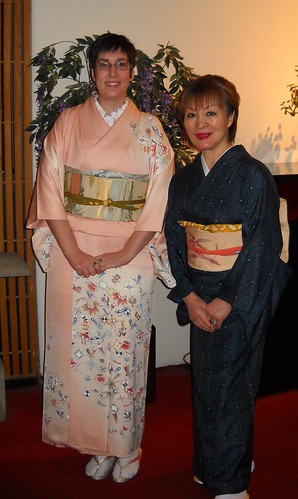
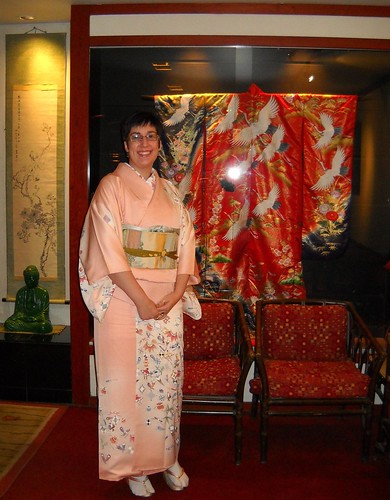
It’s a delicate soft salmon pink with white bokashi (fade-dyeing) around the shoulder and hem. Within the white areas, there are tiny Takara or Lucky Treasures motifs.

Takara-zukushi is a pattern of assembled “takara”, or treasures, which reflect what Japanese people consider valuable.
Needless to say, “takara” comprises of sacks of gold and magical mallets of luck. Buddhist scriptures which can give you knowledge and wisdom is a major treasure too. Counterweights are also “takara” although it may sound odd to you, because they are used as a balance when valuables are weighed. As for the rest of the treasures, “choji” (an herbal medicinal ingredient), “mino” (straw raincoat) and “kasa” (wattle hat) all symbolize something to protect oneself with against calamities and are therefore also considered “takara”.
The sense of “takara” varies by era and locality. Sometimes it comprises of locks, keys, and even ritual articles.

Trying to identify each treasure in a Takara-zukushi pattern is just like opening a jewelry box. In the mood for a treasure hunt? How about looking for interesting and unique treasures on kimonos or obis with the Takara-zukushi pattern!!

Explanation courtesy of Yamatoku.

I am hoping to be able to wear it on my birthday, and I’m going to aim for a very soft, girly, Kimono Salon-style coordination, pairing it up with the beautiful Tokaido obi I received as a gift recently.

Shifuku and Usagi Houmongi

If you’re a regular reader of my blog, you’ve technically already seen this particular kimono, when I wore it out to the park (and then subsequently dinner, but I did not take photos of that) a few weeks back. I finally had some time to take proper catalogue photographs, and it’s a piece that really needs to be appreciated in detail.

The kimono is a subtle pastel gradient. I honestly did not even notice the gentle lavender at the shoulders until I hung it up to take the reference photos. The gold is also really soft and gentle. I don’t typically like large areas of gold leaf on a kimono, but on this one it’s not in-your-face.

However, the real magic is the embroidery on the front panels. I was informed that they are shifuku, or silk pouches used to protect items used during tea ceremony. The embroidery is done entirely in french knots, a technique known as saraga nui. I cannot imagine the time, patience, and skill required to do this.

The most special shifuku in my eyes is by far the one with the adorable white rabbit on it. It’s the sole reason I bought the kimono. He’s just so charming and quirky, on what is otherwise a very subdued and mature kimono.

Trip to the park in a bunny houmongi

I’m back! Sort of! I’m still not 100% better, they’re working on figuring out exactly what is wrong with me. Fun fun. However, I do have a bit more energy now, so when this adorable houmongi with french knot embroidery and a bunny arrived this morning, I decided to tackle it with gusto! I paired it up with a greeny blue fukuro obi with pinkish lavender lines and my blue and red shibori obiage and hakata obijime. A pair of gold and red zori pulled out the gold leaf accents on the kimono nicely.

Astute readers may have noticed something slightly different about my hair 😉 Being trapped inside the house on sick leave for extended periods apparently makes me do wacky things.


In case you’re wondering what my earrings are, they are turquoise Calaveras (day of the dead skulls) with roses in their eyes, from Polished Two on Etsy. They arrived this morning as well, and were the exact same colours as the embroidery on the kimono. I figured I had to wear them.

And in honour of the recently departed Gary Coleman, RIP.
What’chu talkin’ bout, Willis?

For more images, and larger versions, please check out My Flickr.

Gothic Landscape Houmongi

Every so often, you come across a piece that you know you’re just meant to have. Sometimes it’s immediate, and you splurge and buy it. Sometimes you’re not that lucky, and you miss the opportunity. Take solace in the knowledge that eventually, it will find its way back to you.

This curious piece came up for sale, and at the time I didn’t have the money for it. It was purchased by a member of the Immortal Geisha forums, and I happily admired it from a distance, when she posted photos of herself wearing it. Time passed, and she got engaged, and sadly had to sell parts of her collection to fund the wedding. This time, I was ready. I swooped in like a bat in the night (can you tell the mood of the kimono is rubbing off on me? Either that, or the fact that I am currently watching Batman: The Brave and the Bold while writing this) and snapped it up when she put it up for sale.

Damn, was it ever worth the wait. I am fascinated by this kimono. It’s got swirly wrought iron gas lamps, Victorian-style buildings, and what appear to be a series of small grave markers. It reminds me of London in the late nineteenth century.

I wonder if the artist who designed and painted this piece had the same scenes in mind – and if so, what possessed them to make such an odd and unexpected kimono? If not, what were they trying to evoke with this piece, and what would I see if my Western-minded bias were not getting in the way?

Sadly, I’ve not had the opportunity to wear this yet. The woman I bought it from bundled it with a funky shimmery blue-green obi that has a pattern reminiscent of paving stones, and they coordinate very well, but I can’t help think this kimono would look particularly amazing with my equally weird blackbird obi. Crows flying over London, surveying their territory. Hopefully I’ll be able to get the obi re-lined soon, and be able to put together an outfit that does both pieces justice.

Indigo Girl

I’d been waffling about buying a Taisho-era indigo piece for a while when this came up on Ichiroya, and while it was a bit more than I usually pay for kimono, the colour, size, and condition of it were all worth the investment in my mind. This is a houmongi with era-typical long sleeves and a beautiful, multiseasonal floral design. It’s got branches of ume (plum blossom), iris, botan (peony), and bamboo around the hem, and a bold, graphic stem of tachibana, which is probably my favourite floral motif. I love how squishy and fun they look!

It also has some gorgeous, lush embroidery on some of the geometric designs

However, I think one of my favourite things about this kimono is probably one of the most subtle. Woven directly into the fabric, before the dyeing process was started, is a gorgeous red and gold windowpane plaid. You’d never see detailing like this on a modern houmongi, as nowadays that sort of design is considered strictly informal. Naomi wrote a great piece on the qualities of indigo dye, and the transitional phenomenon of putting stripes (which are very casual by modern standards) on more formal kimono. It’s a trend I think is beautiful and needs to come back into vogue.

I’ve worn this kimono once, but only inside the yard, as I’m a little worried about wearing such an old piece out and about. Maybe one day when the right time and place come up, I will do so. I chose to pair it with a late-Showa era obi, which may seem odd but the clouds, grasses, and colours just seemed perfect with it. The obiage and obijime were a gift from a friend, and bring out the soft blue and olive tones in the kimono perfectly. For a vintage feel, I chose some burnt paulownia geta instead of zori.