Shifuku and Usagi Houmongi

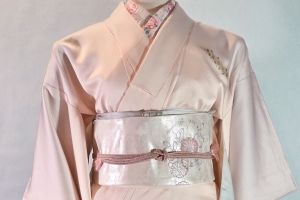
If you’re a regular reader of my blog, you’ve technically already seen this particular kimono, when I wore it out to the park (and then subsequently dinner, but I did not take photos of that) a few weeks back. I finally had some time to take proper catalogue photographs, and it’s a piece that really needs to be appreciated in detail.

The kimono is a subtle pastel gradient. I honestly did not even notice the gentle lavender at the shoulders until I hung it up to take the reference photos. The gold is also really soft and gentle. I don’t typically like large areas of gold leaf on a kimono, but on this one it’s not in-your-face.

However, the real magic is the embroidery on the front panels. I was informed that they are shifuku, or silk pouches used to protect items used during tea ceremony. The embroidery is done entirely in french knots, a technique known as saraga nui. I cannot imagine the time, patience, and skill required to do this.

The most special shifuku in my eyes is by far the one with the adorable white rabbit on it. It’s the sole reason I bought the kimono. He’s just so charming and quirky, on what is otherwise a very subdued and mature kimono.

Back in black, birthday-style.

In my entry about my birthday purchases, I mentioned that I’d gotten one other special piece that I was going to devote an entire entry to. Well, I finally had some free time today to devote to putting an ensemble together and dressing in that piece. Without further ado, allow me to present my kurotomesode/houmongi hybrid mystery kimono!

At first glance, it looks like a subdued kurotomesode, and that is where it was hanging at the kimono showroom. At first I was going to skip over the whole rack, having no real need for more formal items, but I can never pass up a good ogle. While I was rummaging, I noticed something a bit out of the ordinary about this particular piece – there were designs on the sleeves! Kurotomesode, the most formal kimono for married women, is typefied by several things. They are fully black, they have five white crests (three in the back, two in the front), they often have a white second layer known as a hiyoku, and they have designs on the hem only. This one fit all the criteria, but was thrown off by the decorated sleeves.

For the ensemble, I was inspired by the subdued, chic look of geiko in their formal outfits. I paired it up with a warm gold fukuro obi I received as a birthday gift, a white obiage with red shibori clouds, a green and gold obijime to highlight the green in the kimono. Underneath it all I wore a red juban with a lushly textured white and silver haneri. I also put my pearl necklace on, since it was a birthday gift and I felt it was subtle and classy enough not to look out of place.

Full view of the kimono

Close-up of the hem designs

Inside the hem, and the white hiyoku

Design on the sleeve