On Being a Behemoth – Size challenges and how to work with what you’ve got
This article is part of a series on size challenges while collecting and dressing in kimono. Please read Part I
Part II – Tips and Tricks for Dressing
In the first entry of this series, I discussed the importance of buying what fits. However, when it comes to buying vintage, one-of-a-kind textiles, this is obviously not always an option. Sometimes a piece comes along that’s just so stunning that you have to have it, even if it’s not the best fit.
Thankfully, if you can’t make it, you can usually fake it. There are enough tools and tricks out there to help you achieve as smooth and clean a baseline as possible.
Problem 1 – Bosoms a’plenty
This is a problem I suffer from greatly, as do many of my kimono-wearing friends. They’re just not designed for someone with melons like these! The first, and most ideal solution for this is, is a kimono bra. They are available on sites like Rakuten or JShoppers. However, these are again made with smaller Japanese frames in mind, and if you’re as heavily-endowed as I am, it may be a challenge finding one that will fit.
Another solution is sarashi, a cotton binding cloth that is wrapped around the torso. These give a great smooth line from bust to hip while remaining breathable.
One suggestion I have heard of but not tried myself is a
The quickest method, and the one I used to use most often, is the rubber datejime/elastic brace method. This requires a fairly common kitsuke accessory, the rubberized “easy datejime”. I place one of these over my juban with a sports bra underneath. It serves to flatten and hold down my bust.

This solution works well enough, and here are a few outfits for comparison. The plaid ensemble on the left is using this easy method, whereas the flowered ensemble on the right is not – it’s ro, a sheer summer weave, and the fluorescent vivid green of my rubber datejime was way too visible! You can see how much smoother my bust is in the plaid outfit, compared to how it descends and curves over the front of the obi in the flowered one.


The main issue with this method is that the datejime can slip over the course of a long day. I’ve since replaced it with an elasticized velcro abdominal/back support, easily available at any medical supply. I simply wear it above the bust, and it functions almost exactly like sarashi, with the added benefit of extra back support.
Problem 2 – Baby Got Back
Thankfully I don’t have quite as much of a problem with this, but it’s still an issue. The kimono was not designed with hips or a bottom in mind. Once again, your best bet is to find one with a decent hip wrap. If that’s just not feasible, there is an easy and inexpensive way to make sure your kimono doesn’t flap wide open in the front, exposing you in a dramatic and embarrassing way. Simply take a kohrin(kohlin) belt and clip it to the outer flap of your nagajuban, wrap it around your knees, and clip it to the inner okumi panel of the kimono.
SnowFox has made a handy diagram to explain what I mean in a great visual manner.

If you don’t have a kohlin belt, a single suspender from the closet or the thrift store works just as well. Just be sure it’s got plastic grips on the teeth – metal ones might pull or tear vintage silk!
Problem 3 – Big Waist, Little Obi
Vintage obi. They’re beautiful, but they’re also almost always too short and too floppy to work with conveniently. Thankfully this is a problem that plagues the Japanese too, as pretty much everyone was smaller around the waist back then. There’s also the matter of kimono going out of fashion due to the difficulty of putting one on, which led to the development of plenty of tools to help dress.
One great such tool is the obidomekanagu, or obi clip. If you have an obi that’s too short to tie comfortably in a knot before tying your musubi, these are a tiny little pink godsend. Rather than tie the two ends together, you simply clip them together with this tool, nestled snugly in the small of your back, and tuck your obi-makura into the curve at the top. It holds everything into place, and gives you ten to fifteen centimetres of leeway.
Hopefully at least one tip here will help you be a little more comfortable and confident in your kimono! Please let me know what you’d like to see in the next entry of this series, or if you have any tips of your own.
My first furisode – because being a girl both rocks and sucks sometimes.
I was already in my early twenties when I started collecting kimono, and in my mid-twenties when I became serious about it. I’d always told myself I would never buy a furisode, particularly an expensive one, because I was already borderline too old for them, and I don’t go to dressy enough events to justify one. It’s funny how things change.
I’ve already mentioned Vintage Kimono in Boulder in another entry, but that was actually not my first trip there. I go to Boulder with some frequency, as my best friend lives there. The first time I went, I insisted he take me to “this place that sells kimono”, and he was kind enough to come with me.
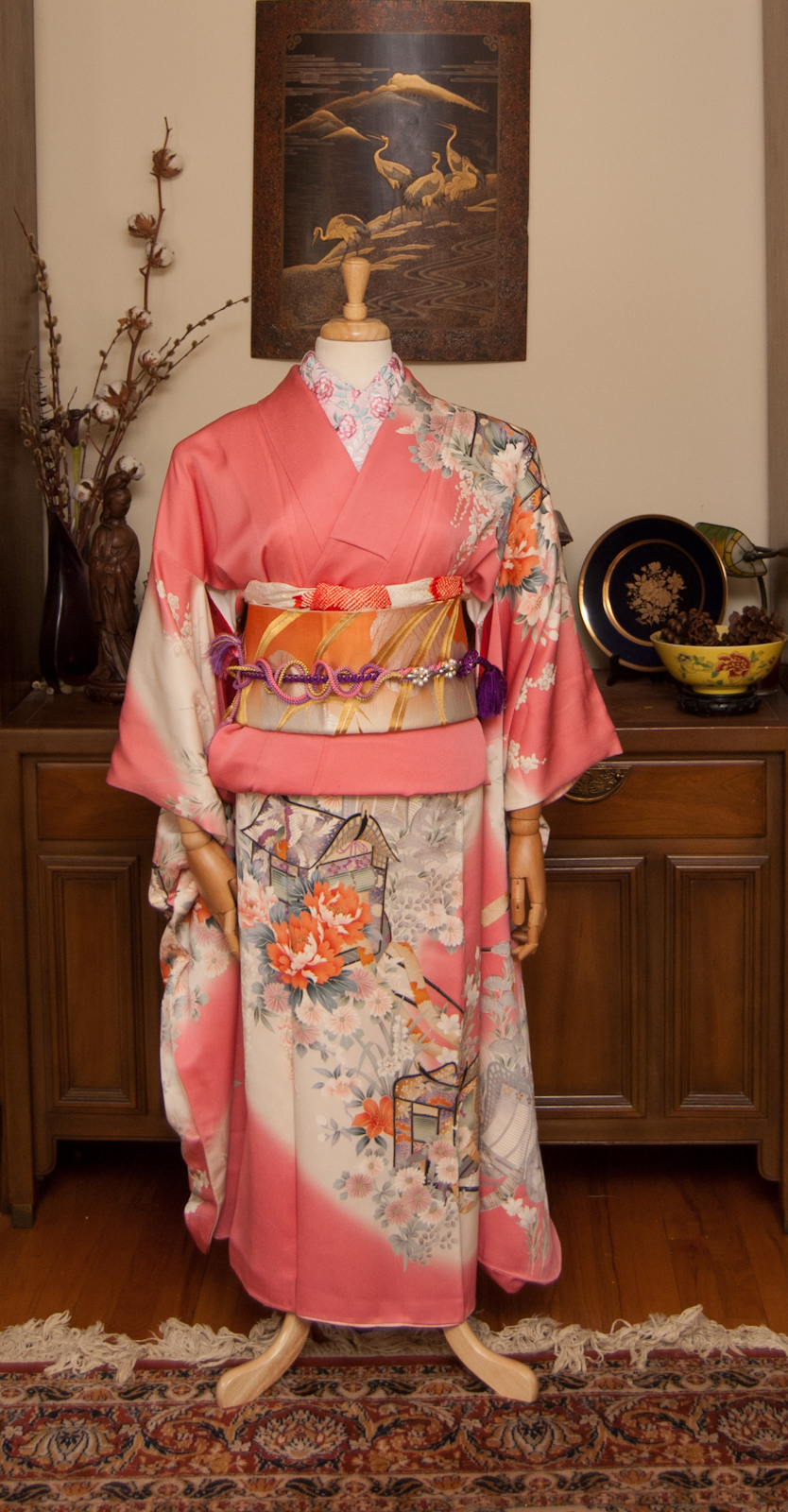
I’d promised myself I was not going to go overboard, and asked him to help me with some restraint. I tried on a few things, put them back, found a haori I’d decided I was going to get, and thought I was done. And then I saw this:

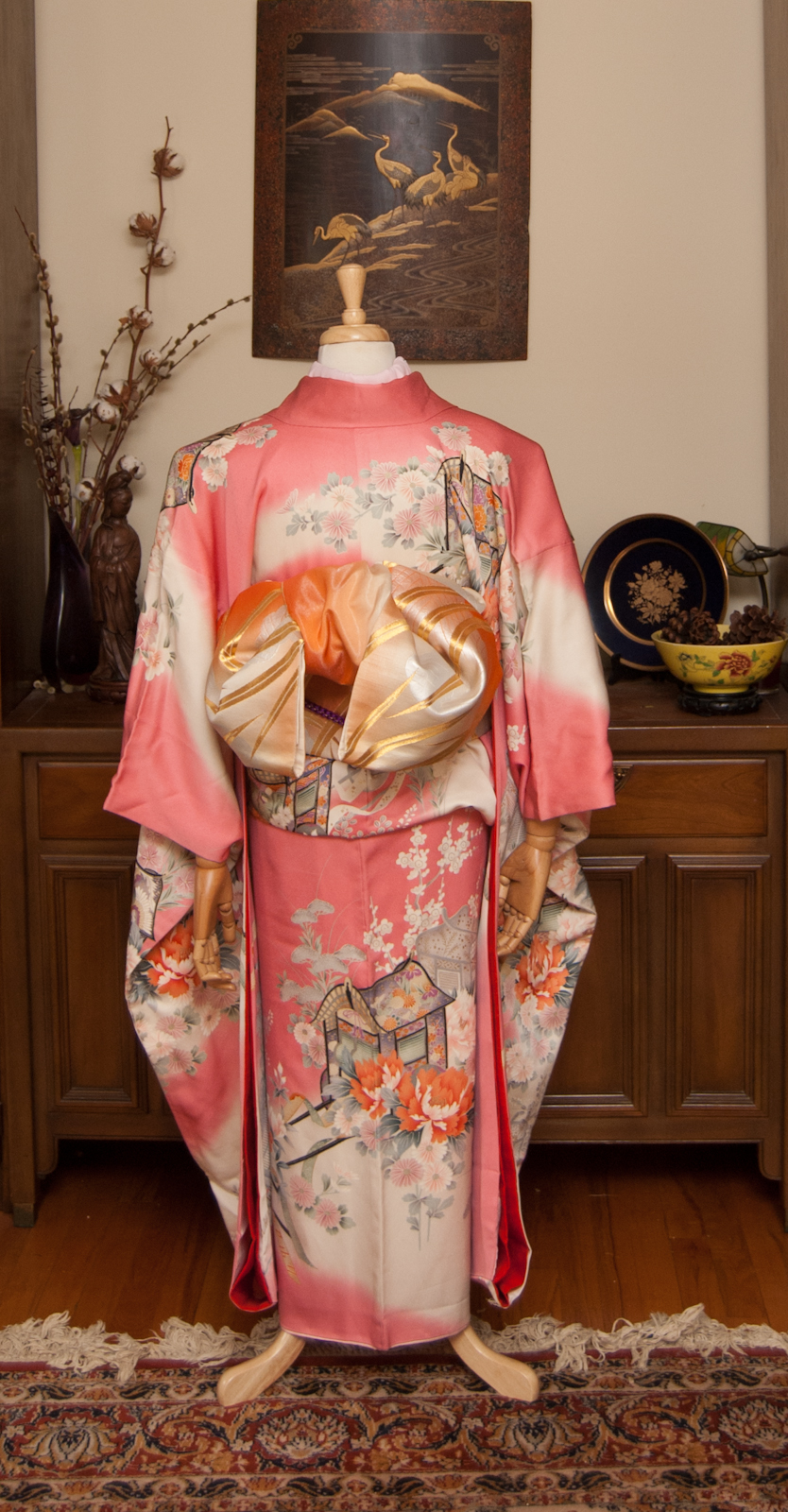
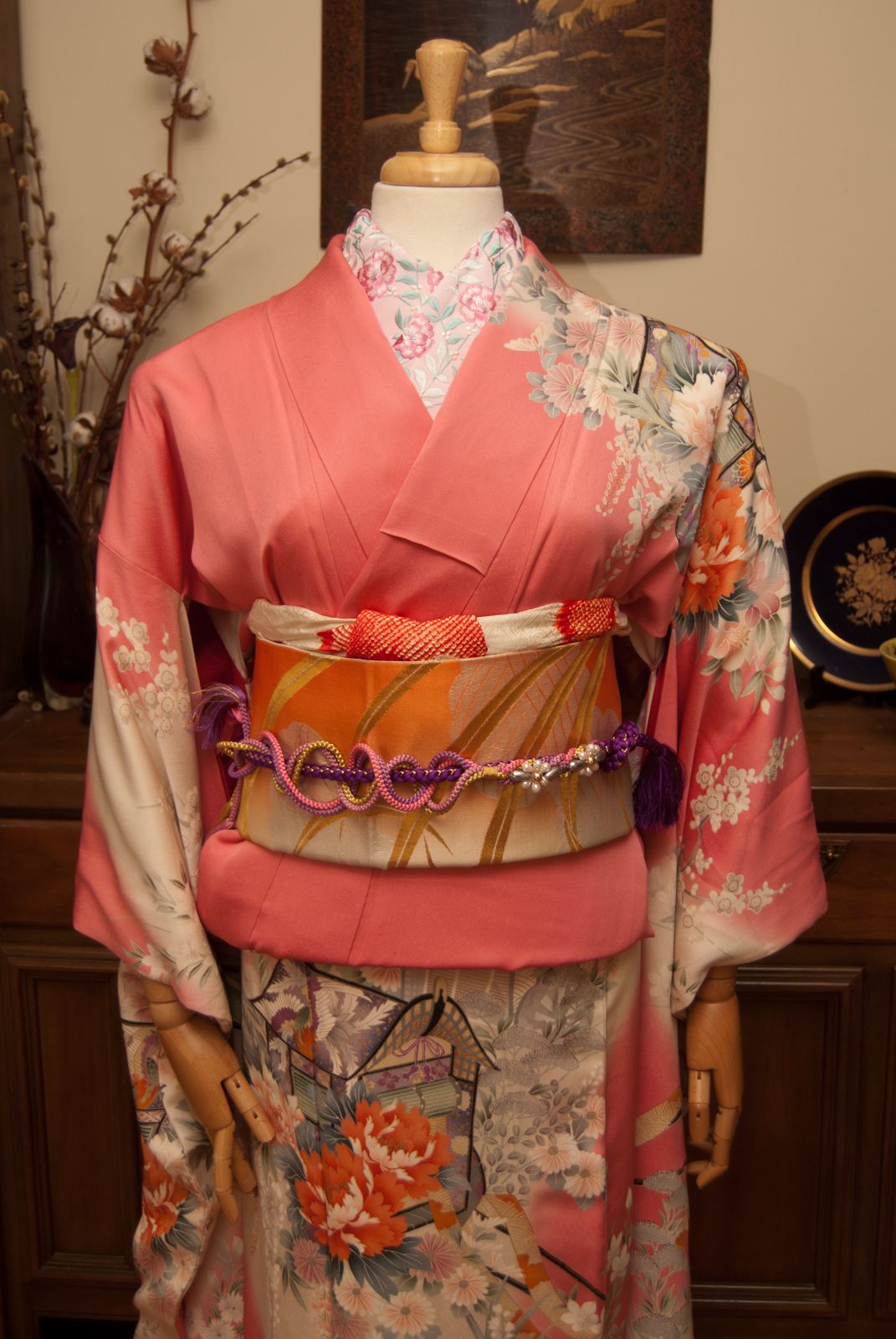
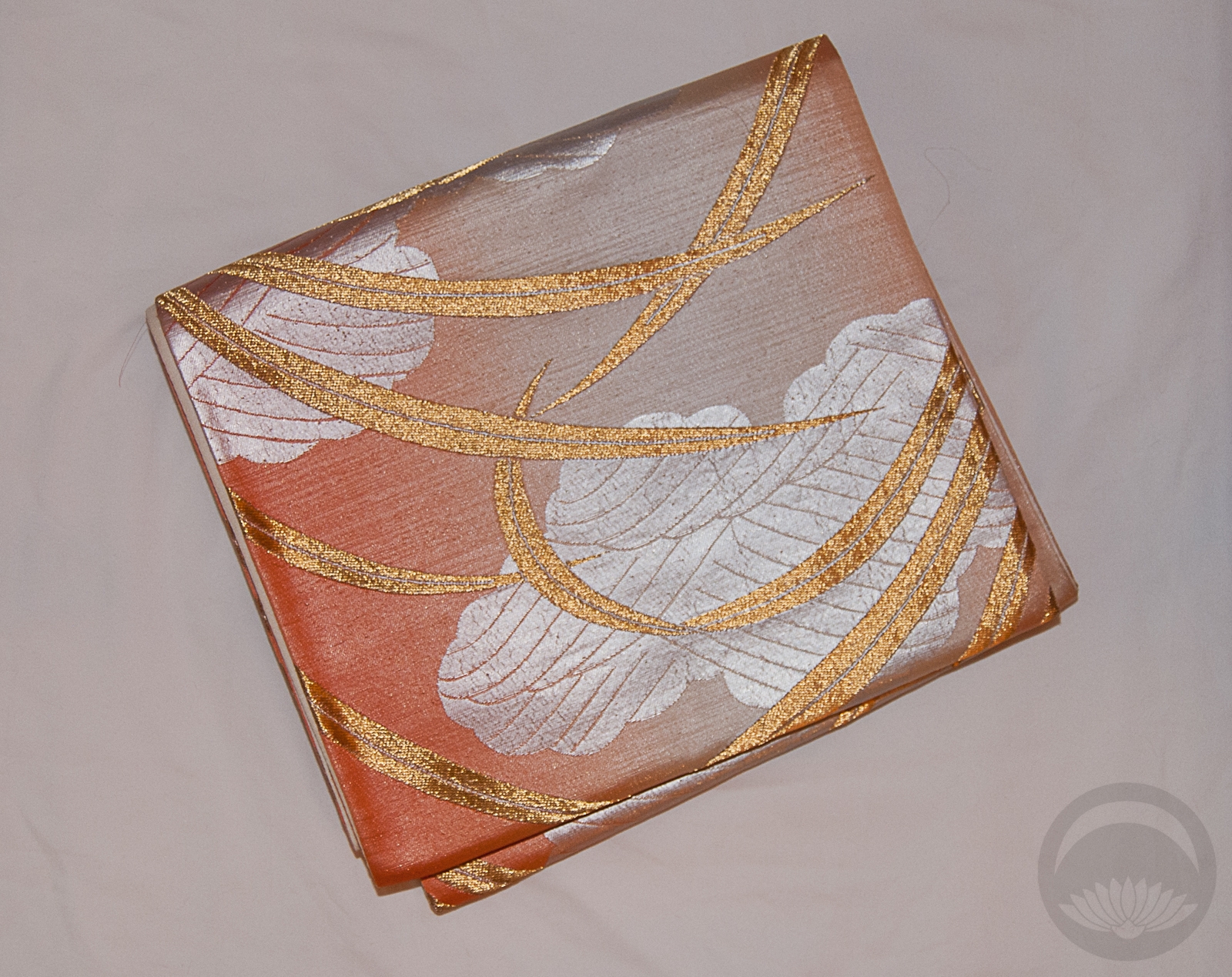
Until this point I hadn’t even found a furisode that interested me – most of them were too gaudy, too youthful, or too colourful. This one drew me in from the moment I saw it. The muted, dusty colours, the relatively (by furisode standards) subdued layout, the gorgeous ruffly peonies. I figured I’d just throw it over my shoulders and imagine myself in it, and be done with it.
So I carefully took it off the rack, and draped it over my shoulders. I looked at my friend. At this point I should probably explain that while he is my best friend and confidant, I am also very much in love with him. I know it’s entirely possible for a man and a woman to be just friends but unfortunately I was not that lucky, and this is where being a girl sucks sometimes. When I posed for him while wearing it, he made this goofy half-smile and said “It looks nice on you” and my heart just melted into a pile of hormonal goo. I knew it was coming home with me, no matter that I had no place to wear it, and could barely afford it. To this day, it’s still one of my favourite pieces, both for its appearance, and because of the memories I have of purchasing it. I’ve only tried it on a few times, since dressing myself in furisode is more complicated and convoluted than it’s worth, but I vow that I will wear it out to an event or party at least once before I turn thirty. I will also wear it better than I did here – these photos were taken before I started properly binding my bust, and I know I folded the hem way too short.
Vintage vibe, modern fit!
Last week I managed to snag an amazing deal. In this entry I mentioned that the best thing a big girl like myself can do is to buy items that fit. Imagine my shock when I found a brand new, synthetic, washable komon that fits me quite well, and has a great vintage vibe to it. Not only that, but it was marked down to $9.85! It arrived in a week, which is even more awesome.
I decided to pair it up with my spider obi – I’d forgotten what a pain in the butt that thing is to tie. Thankfully, my father is patient, kind, and always willing to lend a hand or two when I’m having trouble with my obi. I realized that the mauve on my new embroidred obiage tied into the stripes very nicely, so I decided to use that too.
My dad helped me align my obi so there are three awesome, adorable spiders visible. The tare is a bit long, but that was an intentional decision for optimum spiderosity. Yes, spiderosity is totally a word.
Overall, I’m quite pleased with this outfit. I think maybe an embroidred haneri of some sort might increase the vintage feel, but the white works fine for the time being.
Bonus: I had to kick someone out of “his” chair before taking the pictures. He was not amused.